Monday, July 31, 2006


Sunday, July 30, 2006
Cathliconomics
In the book entitled Freakconomics it theorizes that legalized abortion was the cause of crime reduction in New York in the 1990's. Abortion was legalized around 1970 which is 20 years before the crime rate fell. The claim is that unwanted babies are more likely to become criminals and because they were killed by abortion this reduced the crime rate by 50%. Now there are a lot of arguments for and against this idea but it is still interesting.
But I also have a theory. The pill was introduced in around 1960 in New York. The pill affected the New York population in that “responsible” families, those who could comply with the “wisdom” of fertility reduction, had fewer children. People who were not intelligent, inept, or responsible were not as successful with the cultural value of fertility reduction and had more children. This increase the ratio of children in the population who came from “dysfunctional”parents and this led to a higher crime rate, twenty years later, in the 1980's in New York.
This all reeks of eugenics but I would guess that the culture of contraception has had a more detrimental effect on society than the crime reduction ability of abortion can counterbalance. To bad that many Catholics in America have sold out to the wisdom of fertility reduction [i.e. culture of death] but that is a topic for another post.
But I also have a theory. The pill was introduced in around 1960 in New York. The pill affected the New York population in that “responsible” families, those who could comply with the “wisdom” of fertility reduction, had fewer children. People who were not intelligent, inept, or responsible were not as successful with the cultural value of fertility reduction and had more children. This increase the ratio of children in the population who came from “dysfunctional”parents and this led to a higher crime rate, twenty years later, in the 1980's in New York.
This all reeks of eugenics but I would guess that the culture of contraception has had a more detrimental effect on society than the crime reduction ability of abortion can counterbalance. To bad that many Catholics in America have sold out to the wisdom of fertility reduction [i.e. culture of death] but that is a topic for another post.
Saturday, July 29, 2006
Mozart Made Me Do It
When people ask me about my conversion today, I often tell them I was converted by Mozart. That is an exaggeration, but not far from the truth. It was through music and art that I encountered a positive, inspiring vision of Catholicism. To be young is to be a sensualist, and it was through my ears and eyes that I first became attracted to the faith. Link
Our Pope before he became Pope said the following in regards to Mozart;
You might say that there Mozart thoroughly penetrated our souls, and his music still touches me very deeply, because it is so luminous and yet at the same time so deep. His music is by no means just entertainment; it contains the whole tragedy of human existence. LinkListen to one of B16's favorite songs writen by Mozart; Quintet for Clarinet
Friday, July 28, 2006
Echoing the Argument
I recently had a little interaction with an atheist on You Tube. Here is the comment by an atheist;
All religions rely upon one thing. FAITH. And faith is the belief in something without evidence, proof, or logical rationale. That is the source of all problems. Irrational thought. Faith is the absence and defiance of reason. And that is the bane of our current existence.And my response;
All religions rely upon one thing...transcendence. Reality is something more than what can fit into the human box of evidence, proof, or logical rationale. This is the source of all human hope, that there is something beyond us. Setting faith against reason is irrational. It denies the possibility of the fulfilment of the greatest desire of the human heart.In my argument I tried to use the same structure but with a larger perspective. I think by doing this it makes it easier for the other side see the point. I hope it does not come off like I am mocking the other person. I also tried to use the most general religions position as possible because it makes it harder to go off on tangents. The less bait for tangents the more likely the person will face the core of an argument. But anyway it felt good do some apologetics.
Monday, July 17, 2006
Superman: Type of Christ or Anti Christ?

I have not seen the movie Superman Returns but I have heard very different opinions on the movie. One side says that Superman is portrayed as a dead beat dad not willing to take responsibility for his son and Lois is a single parent shacking up with her boyfriend and the movie sets up a sequel for “Super Bastard”. Some on the other side like the movie because it shows Superman as a type of Christ in that Superman is portrayed as a Christ like savior. Here is a quote...
He [Superman] undergoes something of a via dolorosa in the film, complete with a Kryptonite lance in the side. And his final, heroic act to save the world is one which — apparently — costs him his life. He falls from space to earth in a cruciform shape; the man of the Cross for the salvation of the world.The other view says this...
Some things point us to God in rather direct ways, others more indirectly, and still others show us divine truths by opposition and contrast rather than by similarity. Superman is a figure who is striking not so much for his similarity to Christ, but rather for his dissimilarity.
So is the movie pro-Christ or anti-Christ? I don’t know, I haven’t seen the movie but here are two different opinions...
Hollywood's Caped Messiah
Anti-Christ Superman: The Superhero and the Suffering Servant
Saturday, July 08, 2006
Universal Values
A couple posts back I talked about the opponent’s strategy of dismantling the universal hierarchy of values that our faith professes and I wanted to give a rational argument that defends against this dismantling.
Values do have an element that is subjective but values are also objective in that some values are written into us as humans. We cannot be happy without being connected to something beyond ourselves, something transcendent. It is in our nature to hunger for something beyond us. Our modern society has a metaphysics of materialism which tends to undervalue the intangible. This causes problems because people aim for things that are less than transcendent.
The major faith traditions throughout history testify to needing something transcendent. The Greeks i.e. Aristotle (and latter Christian’s) recognized four levels of happiness. I am quoting the following;
Our materialistic consumer culture tends to overvalue level one and two at the expense of level three and four which puts the hierarchy of values on it's head.
I have used this argument in the most hostile anti-Catholic environment there is, a pro-abortion website, and no one really addressed it head on. Here is the link of this post LINK
Values do have an element that is subjective but values are also objective in that some values are written into us as humans. We cannot be happy without being connected to something beyond ourselves, something transcendent. It is in our nature to hunger for something beyond us. Our modern society has a metaphysics of materialism which tends to undervalue the intangible. This causes problems because people aim for things that are less than transcendent.
The major faith traditions throughout history testify to needing something transcendent. The Greeks i.e. Aristotle (and latter Christian’s) recognized four levels of happiness. I am quoting the following;
1. laetus: Happiness in a thing. Thus, “I see the linguini, I eat the linguini, it makes me feel good, I am happy.” This kind of happiness is based on something external to the self, is short-lived and, on reflection, we do not consider that it is all there is to human happiness.
2. felix: The happiness of comparative advantage. “I have more of this than X.” “I am better at this than X.” This kind of happiness results from competition with another person. The self is seen in terms of how we measure up to others. It has been called “the comparison game.” Such happiness is rather unstable and, if one fails, can lead to unhappiness and sense of worthlessness. Exclusive pursuit tends to oppress others. Most people would not imagine a world as satisfactory if it was composed of only happiness #2 type people.
3. Beatitudo: (Beatitudo = happiness or blessedness). The happiness that comes from seeing the good in others and doing the good for others. It is, in essence, other-regarding action. Happiness #3 is, in some sense, at war with happiness #2. One cannot be at the same time in competition with someone else and doing the good for and seeing the good in them. Most people would prefer a world (community, family, relationships) structured around the pursuit of happiness #3 than entirely based in happiness #2. Happiness #3 is higher than happiness #2. The problem with #3 is that it is necessarily limited. We cannot be someone else's everything. For example, we or they, will die and if our happiness is contingent upon them, it dies with them. “There must be more than this.”
4. Sublime Beatitudo: (sublime = “to lift up or elevate”). This category, the most difficult to describe, encompasses a reach for fullness and perfection of happiness. The fullness, therefore, of goodness, beauty, truth and love. So we recognize in this category, those things that are, in a sense, beyond what we are capable of doing purely on our own. LINK
Our materialistic consumer culture tends to overvalue level one and two at the expense of level three and four which puts the hierarchy of values on it's head.
I have used this argument in the most hostile anti-Catholic environment there is, a pro-abortion website, and no one really addressed it head on. Here is the link of this post LINK
Tuesday, July 04, 2006
Pop Culture Needs a Diaper Change
A lot of popular music comes down to the equivalent of pornography for the ears. But when everyone follows the set program of degradation which sells, there comes a point when the only thing left that is radical is following Jesus. We have reached that point. The following is a song by Kanye West called Jesus Walks. Here is a line from the song;
No truer words have been said in a rap song. lol
Here is a video of the song. Warning: the N-word is used a couple of times. The song has a church militant feel to it which I like.
The way Kathie Lee needed Regis / That's the way y'all need Jesus
No truer words have been said in a rap song. lol
Here is a video of the song. Warning: the N-word is used a couple of times. The song has a church militant feel to it which I like.
Monday, July 03, 2006
The Problem with Preemptive Apologetics
A quote fromMark Shea's blog.
This leads to the obvious question, Am I “full of piss and vinegar?” Before I can answer I need to take a trip to the John.
Part of what fed (and feeds) the interest in apologetics is simply the thrill of learning and articulating the faith. That's certainly what motivates me. People call me an apologist. I generally don't call myself one, because I primarily think of myself as an amateur teacher. I think the Faith is fascinating and just like telling other people about it, because I love to watch the lights come on and I love to watch the Faith liberate other people as it's liberated me. Sometimes that involves "defending the Faith". A lot of times it simply involves proclaiming the Faith.
The two, by the way, are different and those who love apologetics would do well to remember it. The first and primary task of the believer is *not* to defend the Faith, but to proclaim it. In other words, evangelization comes first, and apologetics is, at best, its handmaid. You don't *need* to "defend the Faith* unless the Faith is being attacked. And if you enter into a conversation with a defensive mentality, don't be surprised if you ignite a hostile mentality in the person you are talking to. Not a few times have I seen hot-headed, testosterone-driven young single guys (in short, the sort of person who is typically drawn to apologetics) forget this and come on strong with a pugilistic attitude that radiates "You probably think there's something wrong with my Faith, don't you? Don't you? Come on, try me buddy. Just try me!" Such folk mean well usually. They are young bucks full of piss and vinegar. A thousand years ago, all that masculine energy would have been spent on something like a healthy crusade. But today, there are very few channels through which the Valiant Knight hormones can go, so they go into apologetics, often without anybody to instruct these guys that the medieval ideal also include the model of the verray, parfit gentil knyght who comes in peace before he comes in war. (Link)
This leads to the obvious question, Am I “full of piss and vinegar?” Before I can answer I need to take a trip to the John.
The Strategy of Our Opponents

A quote from a book called Without Roots that I picked up from the library written in part by Pope Benedict (then known as Ratzinger).
a) The first reason was articulated by Nietzsche when he wrote, “Christianity has thus far always been attacked in the wrong way. As long as one does not perceive Christian morality as a capital crime against life, its defenders will always have an easy game. The question of the truth of Christianity...is something entirely secondary as long as the question of the value of Christian morality is not addressed.”
Here what we are actually addressing, in my opinion, is the decisive reason for the abandonment of Christianity: its model of life is apparently unconvincing. It seems to place too many restraints on humankind that stifle its, joie de vivre, that limit its precious freedom, and that do not lead it to open pastures- in the language of the Psalms- but rather into want, into deprivation. Something similar happened in antiquity, when the representatives of the powerful Roman state appealed to Christians by saying: Return to our religion, our religion is joyous, we have feasts, drunken revels, and entertainments, while you believe in One who was crucified.
The Christians were able to demonstrate persuasively how empty and base were the entertainments of paganism, and how sublime the gifts of faith in the God who suffers with us and leads us to the road of true greatness. Today it is a matter of the greatest urgency to show a Christian model of life that offers a livable alternative to the increasingly vacuous entertainments of leisure-time society, a society forced to make increasing recourse to drugs because it is sated by the usual shabby pleasures. Living on the great values of the Christian tradition is naturally much harder than a life rendered dull by the increasingly costly habits of time. The Christian model of life must be manifested as a life in all its fullness and freedom, a life that does not experience the bonds of love as dependence and limitation but rather as an opening to the greatness of life.
In battle it is always a good idea to understand the strategy that an opponent is going to use. Our opponent’s main strategy is not to attack our doctrines through reason. Instead, they aim at dismantling the universal hierarchy of values that our faith professes. Secular values are exalted above religious values and the sacred is demeaned. We need to be vigilant in recognizing these maneuvers because they can be so subtle at times that we don’t even see it and at times we even participate in it.
Tuesday, May 09, 2006
Find True Power

1116 Sacraments are "powers that comes forth" from the Body of Christ, which is ever-living and life-giving. They are actions of the Holy Spirit at work in his Body, the Church. They are "the masterworks of God" in the new and everlasting covenant. (Catechism of Catholic Church)
Monday, May 08, 2006
THE BATTLE OF PRAYER
The best part of the Catechism is its section on prayer. This quote from the Catechism helps put things in focus for me.
With our culture that has so many things to distract us, how can the spiritual battle and the battle of prayer be recognize as reality?
I think the answer to this question can be found in the beatitudes.
THE BATTLE OF PRAYER
2725 Prayer is both a gift of grace and a determined response on our part. It always presupposes effort. The great figures of prayer of the Old Covenant before Christ, as well as the Mother of God, the saints, and he himself, all teach us this: prayer is a battle. Against whom? Against ourselves and against the wiles of the tempter who does all he can to turn man away from prayer, away from union with God. We pray as we live, because we live as we pray. If we do not want to act habitually according to the Spirit of Christ, neither can we pray habitually in his name. The "spiritual battle" of the Christian's new life is inseparable from the battle of prayer.
With our culture that has so many things to distract us, how can the spiritual battle and the battle of prayer be recognize as reality?
I think the answer to this question can be found in the beatitudes.
Sunday, March 26, 2006
Experience & Tradition by Eve Tushnet
I found this very enlightening...
Experience & Tradition
by Eve Tushnet
One of the frightening aspects of loving somebody is the way that love can seem to offer unique access not only to pleasure but to truth. Love of another person-not only romantic love, but familial love and deep friendship as well-promises or threatens to reshape us completely. It can become the lens through which we see the world.
When I came out as a lesbian, provoked in part by a puppyish crush, I felt as though I had found the key that unlocked the secrets of the world. The only experience that has ever given me a greater rush of self-understanding was my conversion to Catholicism. The two experiences felt weirdly similar: both were frightening and illuminating, separating me to a certain extent from friends and family, yet both were prompted by love.
Perhaps this similarity between love of another person and love of God is one reason that Scripture makes love between humans one of its central metaphors for the love story of God and humankind-while also asserting the primacy of the divine love story over, and sometimes against, the human ones. Scripture gives us “His banner over me was love” (Song of Songs 2:4), but also “If any one comes to me and does not hate his own father and mother and wife and children and brothers and sisters, yes, and even his own life, he cannot be my disciple” (Luke 14:26). We should seek to reconcile love of God and love of others whenever they appear to conflict. But we can’t simply assume that such a conflict never exists-or that, if a conflict seems to arise, God couldn’t possibly be asking us to sacrifice a human relationship.
Luke Timothy Johnson’s essay (page 14) touches on some of the deepest questions for a Christian: How do I understand and express my love for others? How should I let love reshape me? How should I read Scripture, especially in light of this love? For the Catholic, Johnson addresses an additional question: How should I read Scripture by the light of the church? And for an American in 2007, he adds a question that has become unavoidable: How can a Christian understand homosexuality?
Johnson’s conclusions are quite different from my own (and don’t reflect my experience). But his questions are the right ones, and his approach is far more fruitful than the ways in which our culture most often handles homosexuality.
Homosexuality has become a cultural battleground for reasons that have very little to do with Catholic morality or scriptural prohibitions. So many people, including many Catholics, meet the idea that gay couples are doing something wrong with blank incomprehension for a lot of reasons. Some are obvious: changing views of sex (including the wishful-thinking belief that birth control has separated sex from reproduction-spend an evening at a crisis pregnancy center and you’ll quickly figure out how much the pill didn’t change); the growing tendency to think of the body more as an instrument, to be used by the mind, than as a sign with its own integrity.
But others are less obvious and perhaps more emotionally powerful. Several recent studies have found that Americans are having a harder time making and keeping close personal relationships. We move halfway across the country, we replace communal gathering places like churches with more solitary “third places” like coffee shops, we have an intense longing for familial connection but terrible difficulty keeping our families together. And so we’re ready to cheer on any kind of personal connection at all, any love that lasts, since we see it much more rarely than we used to.
Anxieties about homosexuality are often driven by anxieties about masculinity. A lot of men, whether consciously or subconsciously, view lesbians as women outside male control, and gay men as traitors and predators, denying their own masculinity and threatening the masculinity of other men. This attitude may be nonsense (how is your masculinity threatened because another guy thinks you’re attractive?), but it’s real. So any discussion of homosexuality taps into deep-seated fears about what it means to be a man, and whether differences between men and women are created by the culture to keep women subordinate. We’re willing to do all kinds of terrible things in order to attain or keep a valued social role, a narrative that makes us feel worthy. For many men, achieving manhood is a major part of their identity. Acceptance of homosexuality-a worldview in which men and women are interchangeable in their sexual and familial roles-can feel deeply threatening. And men whose social roles and sense of their own masculine identity are threatened do sometimes-this is shocking, I know-become irrational and violent.
The often vicious and violent anxiety about masculinity is one reason that the ways in which homosexuality is stigmatized in our culture look nothing like the ways we treat many other things Scripture calls vices. Kids on the playground taunt each other for being gay, even disparaging other kids’ backpacks or pencil cases as “so gay.” People get beaten up or harassed on the street for their real or perceived homosexuality. Parents reject their children for coming out-I suspect most gay people know at least a few friends who were rejected in the most hurtful and vicious ways. (If we care about family breakup, we need to care about families broken by the actions of homophobic parents, as well as those broken by divorce.) This isn’t how we treat the acts we really consider sinful. It’s how we treat scapegoats.
Catholics who find it difficult, even impossible, to believe the traditional Catholic story of sexual morality are often reacting to this cultural landscape. They see devoted couples on one side, violent insecurity and parental rejection on the other. And they see Catholic prohibitions against homosexual acts as providing an excuse for the violent and the cruel.
So it’s tempting to conclude that prohibitions against homosexuality are culture-bound, no more universally binding than the requirement that women cover their heads in church. It’s true that culture conditions how we read Scripture, and that as Christians we need to be open to the countercultural implications of the gospel. But this fact argues far more strongly against Johnson’s position than against the church’s. If we seek to overcome any aspects of our culture that conflict with the gospel, I’m not sure why we would expect the gay liberation movement-slightly over a hundred years old, and largely Western in character-to be less culture-bound, and therefore a better guide to the countercultural aspects of the gospel, than the Catholic Church. The church is bigger and older than you, me, or the very concept of the homosexual person. (The view that sexual orientation is intrinsic and constitutive of a person’s deepest identity comes from a school of psychology that owes very little to the gospel, and a great deal to anti-Christian forms of philosophical materialism.)
Experience is itself a kind of text, and texts need interpreters. How often have we thought that we understood our experiences, only to realize later that we had only the barest understanding of our own motives and impulses? We all know how flexible memory can be, how easy it is to give an overly gentle account of our own motivations, how hard it is to step outside our lifelong cultural training and see with the eyes of another time or place. To my mind, Johnson’s approach places far too much trust in personal experience. He views our experience as both more transparent and less fallible than it is. To take personal experience as our best and sturdiest guide seems like a good way to replicate all of our personal preferences and cultural blind spots. Scripture is weird and tangly and anything but obvious-but at least it wasn’t written by someone who shared all our desires, preferences, and cultural background. At least it wasn’t written by us. And so it’s necessary to turn at least as much skepticism on “the voice of experience” as Johnson turns on the voice of Scripture. It’s necessary to look at least as hard for alternative understandings of our experience as for alternative understandings of Scripture.
And in fact there are theologians who, allowing themselves to be surprised and guided by Scripture and church teaching, have provided accounts of sexuality that resonate with my own experience in a lot of ways. The only theological “school” or approach that has helped me understand at least parts of the church teaching on homosexuality is the theology of the body. This approach, or my understanding of it, is imperfect; but it’s much more convincing to me than the often mechanistic natural-law approaches, which tend to assume cultural consensus on teleology.
As I understand it, the theology of the body takes Jesus’ words on Jewish divorce laws as its starting point: “From the beginning it was not so” (Matthew 19:8). In this approach, we look to Genesis, to the creation narratives, to discover who we truly are and how we could most perfectly relate to one another. Although marriage is the primary focus of the theology of the body, sexual difference is a recurring theme.
And here we discover that la différence is at the heart of human nature. Before we relate to one another as parent and child, worker and boss, artist and audience, soldier and comrade, or any other relationship, we are man and woman. Before we have any other identity (excepting, of course, our most central identity as children of God), we have sexual identity.
I believe that. Through history and in almost all great art, he and she are distinct, and their difference is fundamental in a way that class differences, ethnic differences, maybe even differences of belief are not. And yet every attempt to codify sexual difference fails. People (mostly men) keep making these lists to explain what distinguishes men and women: Women are more practical, or more fickle, or more romantic or less; they’re more nurturing or more petty or more gentle, more selfless or more selfish. These lists aren’t just false, they’re also boring. They take the vivid reality of sexual difference and flatten it out, drain the color from it. What good is an understanding of womanhood that would leave out Shakespeare’s Cleopatra, or Molly Bloom?
The theology of the body, almost alone among theories of la différence, avoids the listmaking trap. Here, man is defined by his longing for woman, woman by her longing for man; this is the “nuptial meaning of the body.” The male becomes a man and the female a woman in their yearning for each other. Love of the other both creates and reconciles the sexes.
There are some obvious attractions of this theology. It’s very beautiful. It reconciles two seemingly irreconcilable facts (the enduring importance of sexual difference, and the impossibility of defining that difference through lists of qualities). It focuses on the creation of identity through love of another, whose otherness remains even as the two become “one flesh.” This supports the metaphorical use of human love in Scripture, and even deepens our understanding of that metaphor.
But there are equally obvious problems with applying this Genesis model to homosexuality. I’ve never found that lesbian women were less womanly, or gay men less manly. Either I’m misunderstanding the implications of the theology of the body, or I’m misunderstanding my own experience. (Or both, of course!) Moreover, showing that homosexual relationships are imperfect, that they do not echo our life in Eden as well as heterosexual relationships can, might not be the same as showing that gay sex is always and everywhere wrong. In his book Gay Marriage: Why It Is Good for Gays, Good for Straights, and Good for America, the gay-rights advocate Jonathan Rauch, an atheist, calls homosexuality “a (mild) disability,” but not an inclination to immorality. And the “theology of the body” approach doesn’t give any guidance on the questions currently most pressing to me: How can I express my love of women in ways consonant with church teaching; and how can I deepen my love of Christ through all the other loves in my life, including romantic love?
So I’m not completely satisfied, yet, with the explanations I’ve seen for church teaching. I do think I’m closer to understanding it now than I was when I was confirmed. I see more of the beauty in the teaching now, and I think I’m at the point of beginning actual theological investigation of the question, rather than just staring at the church in utter confusion. Both the theologians and I have a lot of work to do here. You might even say that Johnson and I agree that what the church has done so far on this issue isn’t enough-we just disagree on which approaches might bear fruit in the future.
The coming-out story is a quintessentially American story. It is self-discovery in opposition to societal regulation. It is personal liberation-as American as “lighting out for the territory.” There are ways to tell the Christian story so that it corresponds very well to this story of self-discovery and liberation: through Christ we are freed from sin and come to know ourselves; in Nietzsche’s phrase, we “become what we are.” But there are other ways of talking about Christian life-ways that focus on sacrifice, martyrdom, dying in Christ to live with him-which are perhaps less quintessentially American, and for that reason all the more necessary for us. There’s a reason all Catholic churches have a crucifix, an image of the tortured God.
Johnson, like many writers who oppose the church’s prohibition against all homosexual acts, points to the real virtues exhibited by so many gay couples: loyalty, caretaking, and compassion. Anyone who supports church teaching must still acknowledge that these virtues are real; that deep, often sacrificial love works through these couples like gold threads in cloth. The question is whether that is enough. How could it not be? How could Christ require more?
And behold, one came up to him, saying, “Teacher, what good deed must I do, to have eternal life?” And he said to him, “Why do you ask me about what is good? One there is who is good. If you would enter life, keep the commandments.” ...The young man said to him, “All these I have observed; what do I still lack?” Jesus said to him, “If you would be perfect, go, sell what you possess and give to the poor, and you will have treasure in heaven; and come, follow me.” When the young man heard this he went away sorrowful; for he had great possessions. (Matthew 19:16-22)
The sacrifices you want to make aren’t always the only sacrifices God wants.
And so the central problem emerges: Whom do we follow? How do we follow love? Can a human beloved have the same ability to overturn us completely-to read and interpret and reshape us-that Jesus himself has? Can love of another person do the same work as the love of God?
Almost all the time, love of God will deepen and strengthen our love of others in obvious ways, rather than conflicting with that love or posing a dilemma. And so we are tempted to believe that our love of God and our love of others won’t ever conflict. But there will be times when it does seem like God is asking us to choose. At the very least, God may require us to radically reshape our understanding of what love of another person should look like. God may ask you not to stop loving your partner but to express that love without sex.
The analogy between God’s love for us and our love for one another is real but partial, and needs to be understood in light of the entire teaching of the church. The church does not teach that whatever anyone does out of a deep conviction and a desire to express love is always intrinsically good. We can sincerely seek to do good and yet actually act wrongly; this happens all the time. Even the saints get stuff wrong, as do all kinds of loving, sincere people. It might even be said that the reason we have church teaching in the first place is that loving, sincere people do their best and still sometimes get things very wrong.
Johnson begins by saying that his position “stand[s] in tension with Scripture.” But he then seems to use human beloveds as a kind of walking Scripture in themselves, able to contradict and correct the merely paper canon. So he writes:
I think it important [for the integrity of our position] to state clearly that we do, in fact, reject the straightforward commands of Scripture, and appeal instead to another authority when we declare that same-sex unions can be holy and good. And what exactly is that authority? We appeal explicitly to the weight of our own experience and the experience thousands of others have witnessed to, which tells us that to claim our own sexual orientation is in fact to accept the way in which God has created us.
I’m not convinced this is how human love stories relate to the divine love story. Loving one another can be an echo of the love we receive from God; it can be the child of that love; it can be preparation for our own awestruck love of God. (I would argue that my erotic and romantic love of women has been all three of those things, at different times.) But our human experience, including our erotic experience, cannot be a replacement for the divine revelation preserved by the church. We must be careful not to let it become a counternarrative or a counter-Scripture.
So we’re left back where we started: with the seemingly irresolvable conflict between the church’s teaching on the one hand, and the difficulty of believing that teaching for many contemporary Catholics.
I am unimpressed with the attempts to resolve the conflict by negating the teaching. And so I have to seek ways to make that teaching more intelligible. I hope this essay has suggested some ways already. Strengthen your families (and your friendships). Accept your children, loving and welcoming them, even, and perhaps especially, when you can’t approve of all of their beliefs or choices. (Welcome your children’s friends, as well, especially those who have been rejected or hurt by their own parents.) Don’t set homosexuality apart, a specially and un-Scripturally stigmatized and identity-shaping category. Accept the sacrifices of Catholic life; don’t try to wriggle out of them when they hurt you, as they inevitably will. Don’t try to ignore them when they hurt someone you love; offer the real compassion of friendship, helping your loved one carry the cross, as Simon of Cyrene did for our Lord, not the false compassion of “whatever you think best, honey.”
I was incredibly lucky. I did not have to overcome familial rejection when I came out. I didn’t face violence or even much teasing. And, of course, this charmed life made it easier for me to believe that Catholic teaching was not based in hatred. I was equally lucky that the friends whose influence ultimately helped me accept the grace of conversion didn’t focus on my sexual orientation. They knew I was gay, and that I was pretty vocal about it. They tried, when I asked, to explain church teaching on homosexuality, but did it very poorly. I’m glad that they instead wanted to talk with me about the Crucifixion as the reconciliation of justice and mercy, or Creation as an explanation of the goodness and intrinsic, poetic meaning of the physical world. There are obviously things that could have been done or said better. I remember one very sweet, good-hearted priest who tried to help me out (again, because I asked him to) by comparing lesbian sex to trying to use a doorknob wrapped in barbed wire. I did my best to cover my bewilderment with politeness.
When I was baptized and confirmed, pledging, “I believe all that the Catholic Church believes and teaches,” I did it basically as a leap of faith. I knew why I needed to be Catholic; I knew that as a Catholic I’d have to follow this stuff, faith seeking understanding and all that; I trusted that eventually I would understand the reasons behind the teaching a little better. And I do. Even so, I waver on how much I think I understand the teaching from day to day.
But what has constantly surprised me about the Catholic Church is just how much there is for me here. There is a rich theology of friendship, helping me to express my love of women both sacrificially and chastely. There’s honor for both celibacy and married life, and resources for living fruitfully in either of these states. We have Oscar Wilde’s fairy tales, we have saints who are possibly even crazier than I am, we have the Anima Christi and Thomas à Kempis’s rewriting of the Song of Songs as a hymn to the crucified Christ. I feel as if every week or so I discover yet another hidden treasure of the church that speaks to me in exactly the way I need in order to deal specifically with my struggles, resentments, longings, and strengths as a woman and a lesbian. We can make the church’s teaching believable by becoming more Catholic-which is, not coincidentally, what we should be doing anyway.
Eve Tushnet is a freelance journalist in Washington, D.C. She blogs at http://eve-tushnet.blogspot.com
Experience & Tradition
by Eve Tushnet
One of the frightening aspects of loving somebody is the way that love can seem to offer unique access not only to pleasure but to truth. Love of another person-not only romantic love, but familial love and deep friendship as well-promises or threatens to reshape us completely. It can become the lens through which we see the world.
When I came out as a lesbian, provoked in part by a puppyish crush, I felt as though I had found the key that unlocked the secrets of the world. The only experience that has ever given me a greater rush of self-understanding was my conversion to Catholicism. The two experiences felt weirdly similar: both were frightening and illuminating, separating me to a certain extent from friends and family, yet both were prompted by love.
Perhaps this similarity between love of another person and love of God is one reason that Scripture makes love between humans one of its central metaphors for the love story of God and humankind-while also asserting the primacy of the divine love story over, and sometimes against, the human ones. Scripture gives us “His banner over me was love” (Song of Songs 2:4), but also “If any one comes to me and does not hate his own father and mother and wife and children and brothers and sisters, yes, and even his own life, he cannot be my disciple” (Luke 14:26). We should seek to reconcile love of God and love of others whenever they appear to conflict. But we can’t simply assume that such a conflict never exists-or that, if a conflict seems to arise, God couldn’t possibly be asking us to sacrifice a human relationship.
Luke Timothy Johnson’s essay (page 14) touches on some of the deepest questions for a Christian: How do I understand and express my love for others? How should I let love reshape me? How should I read Scripture, especially in light of this love? For the Catholic, Johnson addresses an additional question: How should I read Scripture by the light of the church? And for an American in 2007, he adds a question that has become unavoidable: How can a Christian understand homosexuality?
Johnson’s conclusions are quite different from my own (and don’t reflect my experience). But his questions are the right ones, and his approach is far more fruitful than the ways in which our culture most often handles homosexuality.
Homosexuality has become a cultural battleground for reasons that have very little to do with Catholic morality or scriptural prohibitions. So many people, including many Catholics, meet the idea that gay couples are doing something wrong with blank incomprehension for a lot of reasons. Some are obvious: changing views of sex (including the wishful-thinking belief that birth control has separated sex from reproduction-spend an evening at a crisis pregnancy center and you’ll quickly figure out how much the pill didn’t change); the growing tendency to think of the body more as an instrument, to be used by the mind, than as a sign with its own integrity.
But others are less obvious and perhaps more emotionally powerful. Several recent studies have found that Americans are having a harder time making and keeping close personal relationships. We move halfway across the country, we replace communal gathering places like churches with more solitary “third places” like coffee shops, we have an intense longing for familial connection but terrible difficulty keeping our families together. And so we’re ready to cheer on any kind of personal connection at all, any love that lasts, since we see it much more rarely than we used to.
Anxieties about homosexuality are often driven by anxieties about masculinity. A lot of men, whether consciously or subconsciously, view lesbians as women outside male control, and gay men as traitors and predators, denying their own masculinity and threatening the masculinity of other men. This attitude may be nonsense (how is your masculinity threatened because another guy thinks you’re attractive?), but it’s real. So any discussion of homosexuality taps into deep-seated fears about what it means to be a man, and whether differences between men and women are created by the culture to keep women subordinate. We’re willing to do all kinds of terrible things in order to attain or keep a valued social role, a narrative that makes us feel worthy. For many men, achieving manhood is a major part of their identity. Acceptance of homosexuality-a worldview in which men and women are interchangeable in their sexual and familial roles-can feel deeply threatening. And men whose social roles and sense of their own masculine identity are threatened do sometimes-this is shocking, I know-become irrational and violent.
The often vicious and violent anxiety about masculinity is one reason that the ways in which homosexuality is stigmatized in our culture look nothing like the ways we treat many other things Scripture calls vices. Kids on the playground taunt each other for being gay, even disparaging other kids’ backpacks or pencil cases as “so gay.” People get beaten up or harassed on the street for their real or perceived homosexuality. Parents reject their children for coming out-I suspect most gay people know at least a few friends who were rejected in the most hurtful and vicious ways. (If we care about family breakup, we need to care about families broken by the actions of homophobic parents, as well as those broken by divorce.) This isn’t how we treat the acts we really consider sinful. It’s how we treat scapegoats.
Catholics who find it difficult, even impossible, to believe the traditional Catholic story of sexual morality are often reacting to this cultural landscape. They see devoted couples on one side, violent insecurity and parental rejection on the other. And they see Catholic prohibitions against homosexual acts as providing an excuse for the violent and the cruel.
So it’s tempting to conclude that prohibitions against homosexuality are culture-bound, no more universally binding than the requirement that women cover their heads in church. It’s true that culture conditions how we read Scripture, and that as Christians we need to be open to the countercultural implications of the gospel. But this fact argues far more strongly against Johnson’s position than against the church’s. If we seek to overcome any aspects of our culture that conflict with the gospel, I’m not sure why we would expect the gay liberation movement-slightly over a hundred years old, and largely Western in character-to be less culture-bound, and therefore a better guide to the countercultural aspects of the gospel, than the Catholic Church. The church is bigger and older than you, me, or the very concept of the homosexual person. (The view that sexual orientation is intrinsic and constitutive of a person’s deepest identity comes from a school of psychology that owes very little to the gospel, and a great deal to anti-Christian forms of philosophical materialism.)
Experience is itself a kind of text, and texts need interpreters. How often have we thought that we understood our experiences, only to realize later that we had only the barest understanding of our own motives and impulses? We all know how flexible memory can be, how easy it is to give an overly gentle account of our own motivations, how hard it is to step outside our lifelong cultural training and see with the eyes of another time or place. To my mind, Johnson’s approach places far too much trust in personal experience. He views our experience as both more transparent and less fallible than it is. To take personal experience as our best and sturdiest guide seems like a good way to replicate all of our personal preferences and cultural blind spots. Scripture is weird and tangly and anything but obvious-but at least it wasn’t written by someone who shared all our desires, preferences, and cultural background. At least it wasn’t written by us. And so it’s necessary to turn at least as much skepticism on “the voice of experience” as Johnson turns on the voice of Scripture. It’s necessary to look at least as hard for alternative understandings of our experience as for alternative understandings of Scripture.
And in fact there are theologians who, allowing themselves to be surprised and guided by Scripture and church teaching, have provided accounts of sexuality that resonate with my own experience in a lot of ways. The only theological “school” or approach that has helped me understand at least parts of the church teaching on homosexuality is the theology of the body. This approach, or my understanding of it, is imperfect; but it’s much more convincing to me than the often mechanistic natural-law approaches, which tend to assume cultural consensus on teleology.
As I understand it, the theology of the body takes Jesus’ words on Jewish divorce laws as its starting point: “From the beginning it was not so” (Matthew 19:8). In this approach, we look to Genesis, to the creation narratives, to discover who we truly are and how we could most perfectly relate to one another. Although marriage is the primary focus of the theology of the body, sexual difference is a recurring theme.
And here we discover that la différence is at the heart of human nature. Before we relate to one another as parent and child, worker and boss, artist and audience, soldier and comrade, or any other relationship, we are man and woman. Before we have any other identity (excepting, of course, our most central identity as children of God), we have sexual identity.
I believe that. Through history and in almost all great art, he and she are distinct, and their difference is fundamental in a way that class differences, ethnic differences, maybe even differences of belief are not. And yet every attempt to codify sexual difference fails. People (mostly men) keep making these lists to explain what distinguishes men and women: Women are more practical, or more fickle, or more romantic or less; they’re more nurturing or more petty or more gentle, more selfless or more selfish. These lists aren’t just false, they’re also boring. They take the vivid reality of sexual difference and flatten it out, drain the color from it. What good is an understanding of womanhood that would leave out Shakespeare’s Cleopatra, or Molly Bloom?
The theology of the body, almost alone among theories of la différence, avoids the listmaking trap. Here, man is defined by his longing for woman, woman by her longing for man; this is the “nuptial meaning of the body.” The male becomes a man and the female a woman in their yearning for each other. Love of the other both creates and reconciles the sexes.
There are some obvious attractions of this theology. It’s very beautiful. It reconciles two seemingly irreconcilable facts (the enduring importance of sexual difference, and the impossibility of defining that difference through lists of qualities). It focuses on the creation of identity through love of another, whose otherness remains even as the two become “one flesh.” This supports the metaphorical use of human love in Scripture, and even deepens our understanding of that metaphor.
But there are equally obvious problems with applying this Genesis model to homosexuality. I’ve never found that lesbian women were less womanly, or gay men less manly. Either I’m misunderstanding the implications of the theology of the body, or I’m misunderstanding my own experience. (Or both, of course!) Moreover, showing that homosexual relationships are imperfect, that they do not echo our life in Eden as well as heterosexual relationships can, might not be the same as showing that gay sex is always and everywhere wrong. In his book Gay Marriage: Why It Is Good for Gays, Good for Straights, and Good for America, the gay-rights advocate Jonathan Rauch, an atheist, calls homosexuality “a (mild) disability,” but not an inclination to immorality. And the “theology of the body” approach doesn’t give any guidance on the questions currently most pressing to me: How can I express my love of women in ways consonant with church teaching; and how can I deepen my love of Christ through all the other loves in my life, including romantic love?
So I’m not completely satisfied, yet, with the explanations I’ve seen for church teaching. I do think I’m closer to understanding it now than I was when I was confirmed. I see more of the beauty in the teaching now, and I think I’m at the point of beginning actual theological investigation of the question, rather than just staring at the church in utter confusion. Both the theologians and I have a lot of work to do here. You might even say that Johnson and I agree that what the church has done so far on this issue isn’t enough-we just disagree on which approaches might bear fruit in the future.
The coming-out story is a quintessentially American story. It is self-discovery in opposition to societal regulation. It is personal liberation-as American as “lighting out for the territory.” There are ways to tell the Christian story so that it corresponds very well to this story of self-discovery and liberation: through Christ we are freed from sin and come to know ourselves; in Nietzsche’s phrase, we “become what we are.” But there are other ways of talking about Christian life-ways that focus on sacrifice, martyrdom, dying in Christ to live with him-which are perhaps less quintessentially American, and for that reason all the more necessary for us. There’s a reason all Catholic churches have a crucifix, an image of the tortured God.
Johnson, like many writers who oppose the church’s prohibition against all homosexual acts, points to the real virtues exhibited by so many gay couples: loyalty, caretaking, and compassion. Anyone who supports church teaching must still acknowledge that these virtues are real; that deep, often sacrificial love works through these couples like gold threads in cloth. The question is whether that is enough. How could it not be? How could Christ require more?
And behold, one came up to him, saying, “Teacher, what good deed must I do, to have eternal life?” And he said to him, “Why do you ask me about what is good? One there is who is good. If you would enter life, keep the commandments.” ...The young man said to him, “All these I have observed; what do I still lack?” Jesus said to him, “If you would be perfect, go, sell what you possess and give to the poor, and you will have treasure in heaven; and come, follow me.” When the young man heard this he went away sorrowful; for he had great possessions. (Matthew 19:16-22)
The sacrifices you want to make aren’t always the only sacrifices God wants.
And so the central problem emerges: Whom do we follow? How do we follow love? Can a human beloved have the same ability to overturn us completely-to read and interpret and reshape us-that Jesus himself has? Can love of another person do the same work as the love of God?
Almost all the time, love of God will deepen and strengthen our love of others in obvious ways, rather than conflicting with that love or posing a dilemma. And so we are tempted to believe that our love of God and our love of others won’t ever conflict. But there will be times when it does seem like God is asking us to choose. At the very least, God may require us to radically reshape our understanding of what love of another person should look like. God may ask you not to stop loving your partner but to express that love without sex.
The analogy between God’s love for us and our love for one another is real but partial, and needs to be understood in light of the entire teaching of the church. The church does not teach that whatever anyone does out of a deep conviction and a desire to express love is always intrinsically good. We can sincerely seek to do good and yet actually act wrongly; this happens all the time. Even the saints get stuff wrong, as do all kinds of loving, sincere people. It might even be said that the reason we have church teaching in the first place is that loving, sincere people do their best and still sometimes get things very wrong.
Johnson begins by saying that his position “stand[s] in tension with Scripture.” But he then seems to use human beloveds as a kind of walking Scripture in themselves, able to contradict and correct the merely paper canon. So he writes:
I think it important [for the integrity of our position] to state clearly that we do, in fact, reject the straightforward commands of Scripture, and appeal instead to another authority when we declare that same-sex unions can be holy and good. And what exactly is that authority? We appeal explicitly to the weight of our own experience and the experience thousands of others have witnessed to, which tells us that to claim our own sexual orientation is in fact to accept the way in which God has created us.
I’m not convinced this is how human love stories relate to the divine love story. Loving one another can be an echo of the love we receive from God; it can be the child of that love; it can be preparation for our own awestruck love of God. (I would argue that my erotic and romantic love of women has been all three of those things, at different times.) But our human experience, including our erotic experience, cannot be a replacement for the divine revelation preserved by the church. We must be careful not to let it become a counternarrative or a counter-Scripture.
So we’re left back where we started: with the seemingly irresolvable conflict between the church’s teaching on the one hand, and the difficulty of believing that teaching for many contemporary Catholics.
I am unimpressed with the attempts to resolve the conflict by negating the teaching. And so I have to seek ways to make that teaching more intelligible. I hope this essay has suggested some ways already. Strengthen your families (and your friendships). Accept your children, loving and welcoming them, even, and perhaps especially, when you can’t approve of all of their beliefs or choices. (Welcome your children’s friends, as well, especially those who have been rejected or hurt by their own parents.) Don’t set homosexuality apart, a specially and un-Scripturally stigmatized and identity-shaping category. Accept the sacrifices of Catholic life; don’t try to wriggle out of them when they hurt you, as they inevitably will. Don’t try to ignore them when they hurt someone you love; offer the real compassion of friendship, helping your loved one carry the cross, as Simon of Cyrene did for our Lord, not the false compassion of “whatever you think best, honey.”
I was incredibly lucky. I did not have to overcome familial rejection when I came out. I didn’t face violence or even much teasing. And, of course, this charmed life made it easier for me to believe that Catholic teaching was not based in hatred. I was equally lucky that the friends whose influence ultimately helped me accept the grace of conversion didn’t focus on my sexual orientation. They knew I was gay, and that I was pretty vocal about it. They tried, when I asked, to explain church teaching on homosexuality, but did it very poorly. I’m glad that they instead wanted to talk with me about the Crucifixion as the reconciliation of justice and mercy, or Creation as an explanation of the goodness and intrinsic, poetic meaning of the physical world. There are obviously things that could have been done or said better. I remember one very sweet, good-hearted priest who tried to help me out (again, because I asked him to) by comparing lesbian sex to trying to use a doorknob wrapped in barbed wire. I did my best to cover my bewilderment with politeness.
When I was baptized and confirmed, pledging, “I believe all that the Catholic Church believes and teaches,” I did it basically as a leap of faith. I knew why I needed to be Catholic; I knew that as a Catholic I’d have to follow this stuff, faith seeking understanding and all that; I trusted that eventually I would understand the reasons behind the teaching a little better. And I do. Even so, I waver on how much I think I understand the teaching from day to day.
But what has constantly surprised me about the Catholic Church is just how much there is for me here. There is a rich theology of friendship, helping me to express my love of women both sacrificially and chastely. There’s honor for both celibacy and married life, and resources for living fruitfully in either of these states. We have Oscar Wilde’s fairy tales, we have saints who are possibly even crazier than I am, we have the Anima Christi and Thomas à Kempis’s rewriting of the Song of Songs as a hymn to the crucified Christ. I feel as if every week or so I discover yet another hidden treasure of the church that speaks to me in exactly the way I need in order to deal specifically with my struggles, resentments, longings, and strengths as a woman and a lesbian. We can make the church’s teaching believable by becoming more Catholic-which is, not coincidentally, what we should be doing anyway.
Eve Tushnet is a freelance journalist in Washington, D.C. She blogs at http://eve-tushnet.blogspot.com
Wednesday, January 25, 2006
Icon of the Holy Trinity
 The Trinity, Andrei Rublev (1370-1430), Moscow
(Click on image to inlarge)
In Andrei Rublev’s icon, the persons of the Holy Trinity are shown in the order in which they are confessed in the Credo. The first angel is the first person of the Trinity - God the Father; the second, middle angel is God the Son; the third angel is God the Holy Spirit. All three angels are blessing the chalice, in which lies a sacrificed calf, prepared for eating. The sacrifice of the calf signifies the Saviour’s death on the cross, while its preparation as food symbolizes the sacrament of the Eucharist. All three angels have staffs in their hand as a symbol of their divine power.
The first angel, shown at left, is vested in a blue undergarment which depicts his divine celestial nature, and a light purple outer garment which attests to the unfathomable nature and the royal dignity of this angel. Behind him and above his head towers a house, the abode of Abraham, and a sacrificial altar in front of the house. This image of the abode has a symbolic meaning: the house signifies God’s master plan for creation, while the fact that the house towers above the first angel shows him to be the head (or Father) of this creation. The same fatherly authority is seen in his entire appearance. His head is not bowed and he is looking at the other two angels. His whole demeanor - the expression on his face, the placement of his hands, the way he is sitting - all speaks of his fatherly dignity. The other two angels have their heads inclined and eyes turned toward the first angel with great attention, as though conversing with him about the salvation of mankind.
The second angel is placed in the middle of the icon. This placement is determined by the position held by the second Person within the Trinity Itself. Above his head extend the branches of an oak tree. The vestments of the second angel correspond to those in which the Saviour is usually depicted. The undergarment is a dark crimson color which symbolizes the incarnation, while the blue outer robe signifies the divinity and the celestial nature of this angel. The second angel is inclined towards the first angel, as though deep in conversation. The tree behind him serves as a reminder of the tree of life that was standing in Eden, and of the cross.
The angel on the right is the third Person of the Trinity - the Holy Spirit. His light blue undergarment and smoky-green outer garment represent heaven and earth, and signify the life-giving force of the Holy Spirit, which animates everything that exists. “By the Holy Spirit every soul lives and is elevated in purity” - sings the Church. This elevation in purity is represented in the icon by a mountain above the third angel.
Thus Andrei Rublev’s icon, while being an unsurpassed work of iconography, is first and foremost a “theology in color,” which instructs us in all that concerns the revelation of the triune God and the three Persons of the Holy Trinity.
The Liturgy's Source of Beauty
2.2. The noble simplicity of love
The Gospels describe the human and concrete gestures of Jesus: he walks, he blesses, he touches, he heals, he mixes saliva and mud, he raises his eyes to heaven, he breaks the bread, he takes the cup. These are the gestures repeated in the celebration of the sacraments. But it was above all on the night of his passion that Jesus taught us the gestures that we too must perform. He is our master of liturgical education. His art consists in setting forth the essential in a few simple things. The meaning of the liturgy is revealed only through simplicity and sobriety. «He always loved those who were his own in the world. When the time came for him to be glorified by you his heavenly Father; he showed the depth of his love. While they were at supper he took bread, said the blessing, broke the bread, and gave it to his disciples saying […]. In the same way, he took the cup, filled with wine. He gave you thanks, and giving the cup to his disciples, said […] ».[3] What is it that made this act of the Lord so beautiful? The way the room was arranged? The way the table was prepared? Fine table linen? Certainly these things bring out its beauty, like a frame which enhances the beauty of a picture. Yet the real beauty lies in Jesus’ act of redeeming love: «he showed the depth of his love… he took bread». Here lies the beauty of his gesture. Repeating this action of Christ, and recognising in it her Lord’s love, the Church finds it beautiful. The liturgy’s aesthetic value, its beauty, depends primarily therefore not on art, but on the paschal mystery of love. If art is to collaborate with the liturgy it needs to be evangelised by love. The beauty of a Eucharistic celebration essentially depends not on the beauty of architecture, icons, decoration, songs, vestments, choreography and colours, but above all on the ability to reveal the gesture of love performed by Jesus. Through the gestures, words and prayers of the liturgy we strive to repeat and render visible the gestures, prayers and words of the Lord Jesus. This is what the Lord commanded: «Do this in memory of me».
Thursday, January 19, 2006
Effective Apologia
The only really effective apologia for Christianity comes down to two arguments, namely the saints the Church has produced and the art which has grown in her womb.
Better witness is borne to the Lord by the splendor of holiness and art which have arisen in the community of believers than by clever excuses which apologetics has come up with to justify the dark sides which, sadly, are so frequent in the Church's human history.
If the Church is to continue to transform and humanize the world, how can she dispense with beauty in her liturgies, that beauty which is so closely linked with love and with the radiance of the Resurrection?
No. Christians must not be too easily satisfied. They must make their Church into a place where beauty—and hence truth—is at home. Without this the world will become the first circle of hell.
—Joseph Cardinal Ratzinger, The Ratzinger Report
The Feast of St. St. Fabian, 19 January
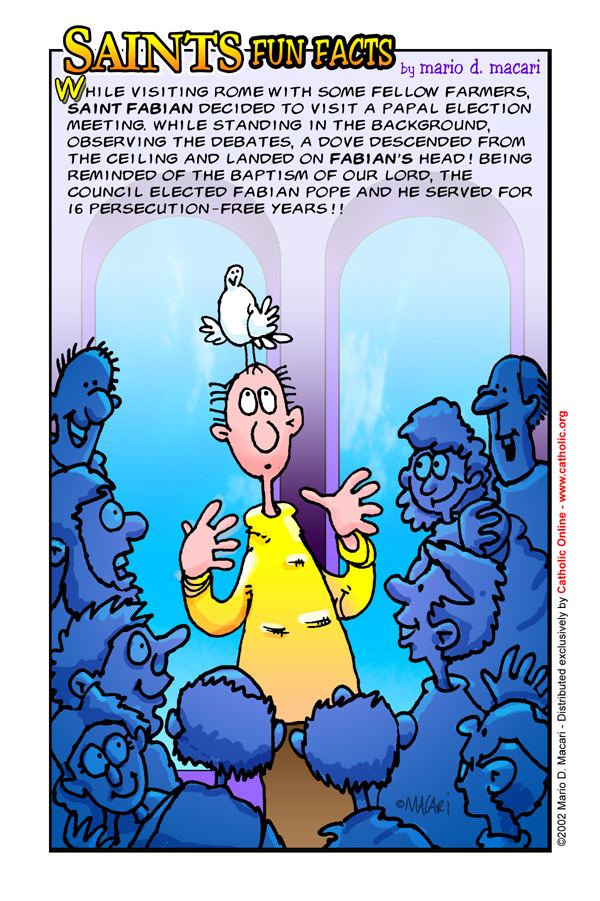
Fabian's election to the papacy (236 - 250 AD) is told by Eusebius in his "Ecclesiastical History" (VI, xxix ):"It is said that Fabian, after the death of Anteros, came from the country along with others and stayed at Rome, where he came to the office in a most miraculous manner, thanks to the divine and heavenly grace. For when the brethren were all assembled for the purpose of appointing him who should succeed to the episcopate, and very many notable and distinguished persons were in the thoughts of many, Fabian, who was there, came into nobody's mind. But all of a sudden, they relate, a dove flew down from above and settled on his head as clear imitation of the descent of the Holy Ghost in the form of a dove upon the Savior; whereupon the whole people, as if moved by one divine inspiration, with all eagerness and with one soul cried out "worthy," and without more ado took him and placed him on the episcopal throne."
Link
Wednesday, January 18, 2006
Bilbo Doll House

If you’re a Lord of the Ring fan or if you love hobbits then you have to check out this dollhouse. The detail of this dollhouse is amazing. Link
Thursday, January 12, 2006
St. Andrew Tie Knot
Well next time you put on your tie to go to Mass make sure that you make a St. Andrew tie knot to give props to Jesus’ worthy servant. I don’t know why I like obscure saint references. I guess because I like subtle reminders of God to be woven throughout my every day experiences.

Legend says that the Apostle St. Andrew was martyred by being crucified to an X because he did not feel worthy to be crucified in the same manner as Jesus. Because of this legend St. Andrew is usually depicted caring a large X and the X has become his symbol. The tie knote is called St. Andrews because it makes an X to tie it. How does this help you in doing apologetics? I don't know, but it can't hurt. Link
St. Andrew tie knot

Subscribe to:
Posts (Atom)
.jpg)