Showing posts with label History. Show all posts

Monday, May 04, 2009

Prolife Movement Weakness

In the Biblical story of David and Goliath, David initially put on a coat of mail and a brass helmet and girded himself with a sword: he prepared to wage a conventional battle of swords against Goliath. But then he stopped. “I cannot walk in these, for I am unused to it,” he said (in Robert Alter’s translation), and picked up those five smooth stones. What happened, Arreguín-Toft wondered, when the underdogs likewise acknowledged their weakness and chose an unconventional strategy? He went back and re-analyzed his data. In those cases, David’s winning percentage went from 28.5 to 63.6. When underdogs choose not to play by Goliath’s rules, they win, Arreguín-Toft concluded, “even when everything we think we know about power says they shouldn’t.Malcolm Gladwell


The prolife movement is in the underdog position. As such it needs to acknowledge its weakness and chose an unconventional [indirect] strategy. The weaknesses as I see them and a quick answer….

  1. It makes us uncomfortable to make others uncomfortable. (blessed are those that mourn)
  2. We don’t want to look intolerant. (blessed are the meek)
  3. We don't want to be judgmental. (blessed those who hunger and seek righteousness)
  4. We don’t want to make people face hard realities and give up potential goals and resources. (blessed are the poor)
  5. We fall for the compartmentalization of separation of Christian ethics from government. (blessed are the pure of heart)
  6. We don’t like to fight. (blessed are the peacemaker)
  7. We don’t want to further hurt those who have had abortions. (blessed are the merciful)
  8. We don’t want to be hated. (blessed are persecuted for seeking righteousness for my sake)

The unconventional strategy should be to follow Jesus in the beatitudes without hesitation.

Wednesday, April 29, 2009

Samurai Saints


ROMA, November 26, 2008 – A samurai carrying the cross is not a conventional image. But there were some of these among the 188 Japanese martyrs of the seventeenth century who were proclaimed blessed two days ago in Nagasaki. There were noblemen, priests – four of them – and one religious. But most of them were ordinary Christians: farmers, women, young people under the age of twenty, even small children, entire families. All of them were killed for refusing to renounce the Christian faith.

The beatification of "Fr. Peter Kibe and his 187 companions" – as the title of the ceremony put it – was the first ever celebrated in Japan. The new blesseds joined 42 Japanese saints and 395 blesseds, all of them martyrs, elevated to the honors of the altar beginning with Pius IX.

The new blesseds were martyred between 1603 and 1639. At the time, there were about 300,000 Catholics in Japan, evangelized first by the Jesuits, with St. Francis Xavier, and then also by the Franciscans. Sandro Magister
HT Mark P. Shea

Friday, May 16, 2008

Constantine and the Catholic Church


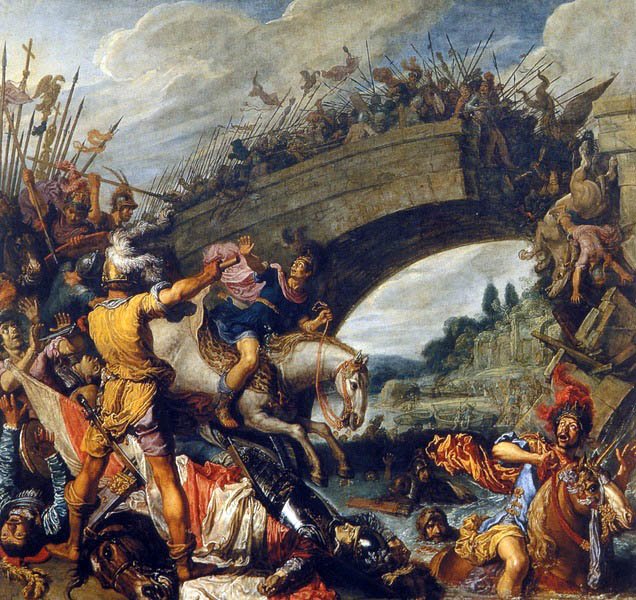
As Constantine rode victorious into the city, Maxentius’s head, raised on spear point, followed him – a trophy for the conqueror, a warning to rivals, a target for the spit of the Roman mob, and something more than all this. For Constantine gave no thanks to the Roman gods. If Maxentius was their champion, here was his head.

Triumphant Constantine, Augustus Maximus of the empire, was about to inaugurate a revolution in the history of the world. Shortly after his victory, Constantine and his fellow Augustus, Licinius, met in Milan to discuss imperial problems. Constantine’s priority was a guarantee of religious freedom, which became known as the Edict of Milan. It is the first legal affirmation of religious liberty, issued more than 1,400 years before a similar idea would be promulgated in America. But what is equally interesting about the Edict of Milan is that it mentions only one specific religion – Christianity – and it is mentioned repeatedly…..

The Edict of Milan, issued by two professing pagans, was the first royal proclamation in a series that would establish Catholic Christianity as the religion of empire, an empire of which it remains the living embodiment, from a beginning that stretches before all time. (H.W. Crocker III)

Wednesday, October 24, 2007

Did God commanded genocide?

A common method to cast doubt on Christianity is to proof text (in a fundamentalist type of way) passages that show that God commanded genocide or some other atrocity. I have never met a Christian who has interpreted these passages as such. Viewed within the context of the Bible, God is ruthlessly just but this must be learned first before his mercy can be fully known. Taken in isolation these passages do become problematic. I think that William Cowper’s poem "God moves in mysterious ways" speaks to this difficulty.

Judge not the Lord by feeble sense,
But trust him for his grace;
Behind a frowning providence,
He hides a smiling face.

His purposes will ripen fast,
Unfolding every hour;
The bud may have a better taste,
But sweet will be the flower.

Blind unbelief is sure to err,
And scan his work in vain;
God is his own interpreter,
And he will make it plain.

Monday, October 22, 2007

A Problem of Language?

Our ancestors tended to personify objects. At least this is my impression of our ancestors. Ships were referred to as women. St. Francis would be a prime example. He made poems about brother sun and sister moon. He preached to birds and admonished wolves. Our current culture seems to go the other extreme. It views things as mere objects or machines. Even other people are viewed in the context of what can it do for me. Here is a quote that I think is insightful:
...but the same problem applies to most of the technological changes we embrace and many of the material and spatial ones. The gains are simple and we know the adjectives: convenient, efficient, safe, fast, predictable, productive. All good things for a machine, but lost in the list is the language to argue that we are not machines and our lives include all sorts of subtleties—epiphanies, alliances, associations, meanings, purposes, pleasures—that engineers cannot design, factories cannot build, computers cannot measure, and marketers will not sell. What we cannot describe vanishes into the ether, and so what begins as a problem of language ends as one of the broadest tragedies of our lives. (by Rebecca Solnit)
So the question that comes to my mind is, why didn't our ancestor's have this problem of language? Or could it be because the concepts of sacred, soul, sin, and sacrifice were not then viewed as outmoded?

Tuesday, October 16, 2007

Cuz it ain’t over tell Jesus returns

Well yesterday in my confirmation class we did the big picture view of salvation history. I showed them some of the basic covenants that God has made in history to bring humanity back to him. My journal question to them was what part did they now play in salvation history? They told me that this was a lot like the question, “What is your purpose?” but I told them that in this context that they would give me more profound answers related to their oath towards Christ. I told them that the story is not over and that the book of Acts was not really completed because the story is still going. When the story is finally told what part will you play in Salvation history?

Thursday, October 04, 2007

Nazi’s, Jews, and Catholics

The Catholic Church often gets slammed for not speaking out against Nazism during World War II. History is never as black and white as popular cultures likes to think. The Catholic Church did try to stay neutral during World War II. The Vatican was surrounded by Nazi allies and to choose sides would have made it a target. There was three options that the Church had. The Church could, 1. Choose sides and speak out against Nazism and be shut down and likely sent to concentration camps. 2. Take an official stance of neutrality but work behind the seen to help the Jews. 3. Do nothing and risk nothing.

So what would have happened if the Church would have taken option # 1 and publicly condemning Nazism? I don’t know if it would have saved a lot of Jews. The Vatican spoke out against the current American war in Iraq and this did not seem to impede the war. I find it unlikely that the Nazi’s would have shut down the furnaces of Auschwitz because the Catholic church condemned what they were doing. I do believe that this is the position that Christ himself would have chosen though. This would have been a hard cross to bare when it’s your own women and children being lead to the concentration camps. (3000 Catholic Priest were killed by the Nazis) If I was Pope during that time, and I’m glad I’m not, I don’t know if I could have chosen this hard road. I don’t think I would have the strength.

I believe that option # 2 is what the Catholic Church did. If you look for where the Catholic Church acted to try to help the Jews you will find some really admirable acts by the Catholic Church. (see this Jewish perspective) If your question is where did the Catholic Church failed to act, you will find plenty as well (another Jewish perspective).

If you look at option #3 it is really hard to say that this is what the Catholic Church did. The truth is that the Catholic did act and it did take risks to help the Jews although it could have acted more. Popular culture likes to believe that the Catholic Church did not act at all and this is simply untrue (as the first link above shows)

Wednesday, September 19, 2007

NPR, Nazis, and Abortion

I listened to NPR on the radio today while traveling for work. The program talked about a photo album of Nazi officers who worked at Auschwitz. The photos showed these officers participating in normal activities. The photos are now part of the United States Holocaust Memorial Museum. The discussion was on how everyday people have the capacity for evil just like these Nazi officers. We have to be vigilant to make sure this doesn’t happen again.

So wake up NPR. The truth is that it is happening again and in our very own country. Abortion kills humans. The only difference between a Jew and a fetus is the stage of development. One day there will be the United States Abortion Memorial Museum and we will have pictures of people involved with abortions participating in normal activities. Pictures of NPR staff will be a part of the exhibit since they serve as the propaganda machine for abortion.

Thursday, September 06, 2007

The Natural Origins of the All Male Priesthood

The tradeoff approach yields a radical theory of gender equality. Men and women may be different, but each advantage may be linked to a disadvantage.

Hence whenever you hear a report that one gender is better at something, stop and consider why this is likely true — and what the opposite trait might be good for. LINK


This article written by Roy F. Baumeister is from a secular evolutionary perspective but I think it has a lot of truth to it. It lays the foundation for the natural basis of why the Catholic Church has institutionalized an all male priesthood. There is too much good stuff to quote so I will just let you read it and draw the connections yourself. I highly remcommend reading the article.

This is the authors conclusion of a male lead society...

Again, I’m not saying it’s right, or fair, or proper. But it has worked. The cultures that have succeeded have used this formula, and that is one reason that they have succeeded instead of their rivals.

Saturday, September 01, 2007

Greatest Catholic Quotes of All Time (Almost)

Greatest Catholic Quotes of All Time (Almost)

How is this related to Catholic Apologetics?

These quotes show that the Catholic faith has a long tradition that spans from the time of Christ tell now. It also shows some of the wisdom that the Catholic faith has.

Wednesday, August 29, 2007

Medieval Voting

Voting in Medieval Universities and Religious Orders

This looks interesting although it is not light reading.

Saturday, December 31, 2005

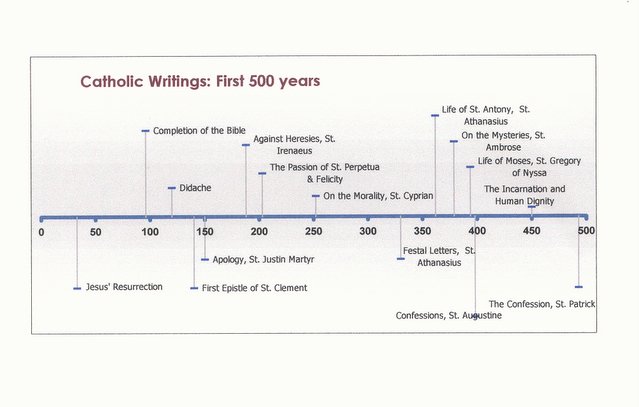
Catholic Writings: First 500 years


This is for a project that I am doing for Phatmass. Link Posted by Picasa

Thursday, December 15, 2005

X-Mass???

From EWTN;

How and when did the use of X-Mas in the place of Christmas get started?

Generally, the term X-mas has negative connotations today owing to its rather frequent use as a kind of secular euphemism for Christmas. The historical origins of the word, however, are found in the Greek for Christ (Kristos, Xristos). Early printers in the West adopted the X as an abbreviation for Christ to save a little money on the typesetting. The usage found wider acceptance and Xmas has been used by earnest Christians ever since.

While this origin of the term points to intentions that were entirely respectful, many of the current uses are far from rooted in good intentions.

COPYRIGHT 2005


Link

Hubert, Patron Saint of Hunters


From The Catholic Encyclopedia;

On Good Friday morn, when the faithful were crowding the churches, Hubert sallied forth to the chase. As he was pursuing a magnificent stag, the animal turned and, as the pious legend narrates, he was astounded at perceiving a crucifix between its antlers, while he heard a voice saying: "Hubert, unless thou turnest to the Lord, and leadest an holy life, thou shalt quickly go down into hell". Hubert dismounted, prostrated himself and said, "Lord, what wouldst Thou have me do?" He received the answer, "Go and seek Lambert, and he will instruct you."

Accordingly, he set out immediately for Maastricht, of which place St. Lambert was then bishop. The latter received Hubert kindly, and became his spiritual director. Hubert, losing his wife shortly after this, renounced all his honors and his military rank, and gave up his birthright to the Duchy of Aquitaine to his younger brother Eudon, whom he made guardian of his infant son, Floribert. Having distributed all his personal wealth among the poor, he entered upon his studies for the priesthood, was soon ordained, and shortly afterwards became one of St. Lambert's chief associates in the administration of his diocese.


Link

Saturday, September 10, 2005

Caesarea Philippi and the Rock

Caesarea Philippi is the location where Jesus’ identity as the Messiah was revealed to the disciples. Caesarea Philippi was a two-day walk into pagan territory so it is odd that Jesus would take his disciples there. By Caesarea Philippi there is a huge rock with a cave that is the source of the Jordan River. The pagans believed that the cave with the water flowing out from under the ground was a gate to hades, the gates of hell.


At this rock, pagans would worship the pagan god Pan. Here is a picture of a couple of niches that probably held a statue of Pan. Pan was the pagan god of shepherds and flocks.


On top of the rock there was a temple for the worship of Caesar (see Josephus Ant. 15).

This backdrop is very significant in relation to what Jesus says in Matthew 16:13-20. Jesus established Peter as the true shepard of his true flock in opposition to Pan the false god of shepherds and flocks. And the true divine king, Christ, is going to build his Church on Peter, the Rock, in opposition to the false god Caesar and his false church on the rock. And the gates of hell will not prevail against the Church that Christ established.

Sunday, September 04, 2005

The Catholic Roots of Human Rights


The Catholic Church played a big role in the development of our modern understanding of human rights. This fact has been neglected by historians but this is starting to change do to the work of Brian Tierney. Canon law and the concept of Natural law set the stage for the understanding of human rights. Here is a quote from a article that I found. It's an interesing read.

______________________

The evolution of a language of rights is only part of the story of this first "context." By the year 1300, the jurists of the Ius commune had developed a sturdy language of rights and created a number of rights derived from natural law. During the period from 1150 to 1300, they defined the rights of property, self-defense, non-Christians, marriage, and procedure as being rooted in natural, not positive, law. By placing these rights squarely within the framework of natural law, the jurists could and did argue that these rights could not be taken away by the human prince. The prince had no jurisdiction over rights based on natural law; consequently these rights were inalienable.(16)
_________________________________________

The History of Rights in Western Thought


It is also Ironic that society is now rejecting natural law when it is the foundation of human rights.

Saturday, September 03, 2005

The Oldest Existing Christian Hymn


The Oxyrhynchus hymn is the oldest existing Christian hymn that we have the notes for, dating from the second or third century AD. We have the words to older hymns but we really do not know how the melody went. It is also interesting that this hymn was found in a old dump near Egypt. Here are the words to the hymn which are beautiful:

________________
...Let it be silent,Let the Luminous stars not shine, Let the winds and all the noisy rivers died down; And as we hymn the Father, the Son and the Holy Spirit, Amen Let all the powers add "Amen Amen"praise always, and glory to God,Amen Amen The sole giver of good things, Amen Amen.
________________

As for indirect apologetics it is note worthy to point out that it is a hymn to the Trinity.

Here is some links one of which has audio of how the hymn sounded.

Oxyrhynchus hymn Audio
Oxyrhynchus hymn

Sunday, June 19, 2005

The Indirect Approach Tradition

It is interesting to trace back the origins of an idea. I first came across the indirect approach when I picked up the book, Strategy. I bought the book to see if I could glean anything from the military strategy of war that would apply to the spiritual battles of the Kingdom of God. Strategy takes major military battles of history and looks for common factors that determined victory or defeat. The main premise of the book is that the more indirect an attack, the higher the likelihood of success. This principle, played out in history is fascinating and I quickly applied this concept to online apologetics.

The indirect approach is not a new idea in apologetics. It has been used throughout history to win over hearts and minds. Kierkegaard coined the term indirect communication and used this strategy in his writings. He wrote the following about his approach…

No, an illusion can never be destroyed directly, and only by indirect means can it be radically removed. If it is an illusion….and if there is anything to be done about it, it must be done indirectly,.... There is nothing that requires such gentle handling as an illusion, if one wishes to dispel it. If anyone prompts the prospective captive to set his will in opposition, all is lost. And this is what a direct attack achieves, and it implies moreover the presumption of requiring a man to make to another person, or in his presence, an admission which he can make most profitably to himself privately. This is what is achieved by the indirect method, which, loving and serving the truth, arranges everything dialectically for the prospective captive, and then shyly withdraws (for love is always shy), so as not to witness the admission which he makes to himself alone before God—that he has lived hitherto in an illusion (Kierkegaard, The Point of View for My Work
as an Author
, p. 24ff).

Kierkegaard wrote philosophical stories, under a pseudonym, to demonstrate his ideas. Many of his stories did not provide answers, this would be a direct attack. Instead, his stories brought forth questions that pointed to Christ.

In practice, the indirect approach has been used by some of the most influential people in history. Paul at times used the indirect approach. He became "all things to all, to save at least some”. Jesus taught mostly by way of parables, which is an indirect method. In fact, Jesus’ life itself was indirect. The King of kings did not come with riches and earthly glories but was born incognito in a manger to a poor humble family. He conquered sin and death, non-directly, by submitting to the will of the Father and laying down his life on the cross. Socrates would be another example. Socrates claimed not to have wisdom, but by asking questions he was able to bring people on the journey of truth.