Showing posts with label Bible. Show all posts

Monday, May 04, 2009

Prolife Movement Weakness

In the Biblical story of David and Goliath, David initially put on a coat of mail and a brass helmet and girded himself with a sword: he prepared to wage a conventional battle of swords against Goliath. But then he stopped. “I cannot walk in these, for I am unused to it,” he said (in Robert Alter’s translation), and picked up those five smooth stones. What happened, Arreguín-Toft wondered, when the underdogs likewise acknowledged their weakness and chose an unconventional strategy? He went back and re-analyzed his data. In those cases, David’s winning percentage went from 28.5 to 63.6. When underdogs choose not to play by Goliath’s rules, they win, Arreguín-Toft concluded, “even when everything we think we know about power says they shouldn’t.Malcolm Gladwell


The prolife movement is in the underdog position. As such it needs to acknowledge its weakness and chose an unconventional [indirect] strategy. The weaknesses as I see them and a quick answer….

  1. It makes us uncomfortable to make others uncomfortable. (blessed are those that mourn)
  2. We don’t want to look intolerant. (blessed are the meek)
  3. We don't want to be judgmental. (blessed those who hunger and seek righteousness)
  4. We don’t want to make people face hard realities and give up potential goals and resources. (blessed are the poor)
  5. We fall for the compartmentalization of separation of Christian ethics from government. (blessed are the pure of heart)
  6. We don’t like to fight. (blessed are the peacemaker)
  7. We don’t want to further hurt those who have had abortions. (blessed are the merciful)
  8. We don’t want to be hated. (blessed are persecuted for seeking righteousness for my sake)

The unconventional strategy should be to follow Jesus in the beatitudes without hesitation.

Thursday, May 29, 2008

Suffering

We look in vain for an emotionally satisfying answer to suffering because suffering is inherently a matter of being separated from the good. Complaining that there is not a “satisfying” answer to suffering is like complaining that water is wet.

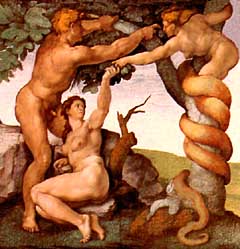
Suffering is a consequence of Adam and Eve disobeying God. Adam and Eve ate of the tree of knowledge of good and evil. This knowledge is not the bookish type of knowledge. It's the experiential type of knowing. Peter Kreeft said the following in regards to the word knowing, “The same word is used in Genesis 4 for sexual intercourse: Adam "knew" Eve and the result was not a book but a baby.”

Suffering is a result of experientially knowing what evil is. It is the experiencing of what it means to be separated from the source of all good. There had to be some type of consequence that results from our free choices for there to be any meaning behind our actions. The consequence was not just an experience of suffering but also a separation from grace. Due to original sin, human nature is a little bit off and weakened.

The experience of suffering really could have be worse. God's justice demands the consequence of suffering but there is also the mercy that we are not totally deprived of God's goodness. We are still able to know goodness and we still have the ability to be reconciled to God and His grace.

Suffering does say a lot about God. The Christian God is courageous; reckless even from the human point of view. When humans create a computer simulation of the world, we make it safe. There are reset buttons and little to no consequences.

The Christian God is not playing games with the world. There are real consequences and the stakes are high. Free will gives us the ability to love but it is not without a cost. With the ability to choose to love there is also the power to reject God and his love. We are living God's story. In this story there are real dangers with real suffering. God has allowed suffering but he has conquered suffering also. Jesus took on all the sins of humanity during His passion and as a result, all the eternal debt that justice requires. He is a God that chose to test himself through taking on human weakness. He tested himself to the point that he descended into hell. He saw the world from the view of our sin and human weakness, even to the point of a despairing atheist. He was able to say on the cross, ""My God, my God, why hast thou forsaken me?" Matt 27:46 Jesus had not given up trust or faith in himself but had taken on the weakest part of humanity. He was quoting Psalm 22 which does not end in despair, surrender, or failure. (Go Read Psalm 22 to find out the full scope of what Jesus was saying)


The Christian God is strong enough even to die and in so doing Jesus conquered suffering, sin, and death when he rose from the dead. We are part of God's story and in this story it does not always make sense to us. Being separated from God -due to original sin- we are blinded by our human weakness. We have to trust and follow Christ through His-story because, “God is his own interpreter, And he will make it plain.”

(Images from Grünewald's Isenheim Altarpiece)

Wednesday, May 21, 2008

The Old Testament God of Wrath and Justice

It's often said that the Old Testament, especially Genesis, teaches a God of justice, in stark contrast to Jesus, who teaches a God of forgiveness and love. It is a lie, of course. The God of the Old Testament does all that He does out of love; and the Father of Jesus needs to satisfy justice as well as love; that's why Jesus had to die. I used to think that only those who never read the Bible could fall for this fallacy. But experience has taught me otherwise. Why is it so common?

I think it comes partly from misunderstanding the literary style of Genesis. It is not meant to be psychology, either of God or humanity. The modern style of storytelling emphasizes psychological motives and scrutinizes inner consciousness. This is simply not the style of premodern writing. Augustine's Confessions is the only personal introspective autobiography in premodern literature.

Thus the “wrath of God” is not meant as a description of God's own private feelings, but of His public deeds, of how those deeds look to fallen, “wrathful” man. Psychologically, this is “projection”. When God gave Lady Julian of Norwich a “showing” of His wrath, she said, “I saw no wrath but on man's part.” (Peter Kreeft)

Monday, May 05, 2008

Mary's Love and Obedience


This picture of Mary holding the corpse of Jesus is very moving to me. The absence of detail and the deep red that permeates the picture seems to become a part of me. As if, in closing my eyes, the picture would still be present.

The love that Mary has for Jesus comes though. It is a picture of a mother's love. Mary didn't fight God's will by demanding that Jesus turn away from what he was called to do. She did not demand that Jesus submit to her though the commandment, honor thy father and mother. Instead she was obedient to God's will so that her son could be given for all humanity.

Mary's head is in line with Jesus' head in the picture, like she is ready to follow him even in death. Mary is cradling Jesus like she must have done when she presented the infant Jesus at the Temple. The following was said to her...


And Simeon blessed them, and said to Mary his mother: Behold this child is set for the fall, and for the resurrection of many in Israel, and for a sign which shall be contradicted; And thy own soul a sword shall pierce, that, out of many hearts, thoughts may be revealed. (Luke 2:34-35)
This picture, I believe, depicts Mary's pierced soul. Through it -in my heart- thoughts are revealed. Thoughts of God's love and what has been done for me. It makes me sad in that I have fallen short and betrayed Christ. But it also gives me hope for the coming resurrection. Thanks Mary for your Son, prayers, and obedience.

Sunday, May 04, 2008

The Tree of Knowledge of Good and Evil


I'm currently reading a book on the Bible by Peter Kreeft. I'm only a couple of chapters into it but it is good. It goes book by book through the Bible and touches on the basics. I think it's important to always go back to the basics. Anyway, the quote I'm going to post, from the book, is talking about this following passage...

But of the tree of knowledge of good and evil, thou shalt not eat. For in what day soever thou shalt eat of it, thou shalt die the death. (Gen 2:17)


And from the book...

By the way, the word knowledge here means "experience". God wanted to keep us from the knowledge of good-and-evil that comes from experiencing and tasting it (thus the image of eating fruit), not from the knowledge that understands it. The same word is used in Genesis 4 for sexual intercourse: Adam "knew" Eve,and the result was not a book but a baby.(Peter Kreeft)
I always read the word knowledge in verse 17 as a mental understanding. I also got a chuckle out of how Kreeft explains it.

Wednesday, October 24, 2007

Did God commanded genocide?

A common method to cast doubt on Christianity is to proof text (in a fundamentalist type of way) passages that show that God commanded genocide or some other atrocity. I have never met a Christian who has interpreted these passages as such. Viewed within the context of the Bible, God is ruthlessly just but this must be learned first before his mercy can be fully known. Taken in isolation these passages do become problematic. I think that William Cowper’s poem "God moves in mysterious ways" speaks to this difficulty.

Judge not the Lord by feeble sense,
But trust him for his grace;
Behind a frowning providence,
He hides a smiling face.

His purposes will ripen fast,
Unfolding every hour;
The bud may have a better taste,
But sweet will be the flower.

Blind unbelief is sure to err,
And scan his work in vain;
God is his own interpreter,
And he will make it plain.

Thursday, September 27, 2007

Baby Got Book

I got this from my sister and it’s funny.


We both like the part where it says, "and if you're Catholic there's even more"

If you're looking to read more about why Catholic’s have a bigger Bible go here

Monday, August 20, 2007

Old Testament Difficulties and the Ban

One of my earliest memories is watching tv while my parents wallpapered the room. I was probably around 5 years old. My dad had got a bag of M&M’s when he bought some of the wallpaper supplies. I remember my dad telling me that I needed to stop eating the M&M’s because I was going to get a stomach ache. I ignored him and kept eating. He told me again to stop eating because I was going to make myself sick. I have talked with my dad about this incident when I was an adult and he remembered it. He told me that I gave him a look that said, “you cheap ass”. My dad finally said, “Fine, eat as much as you want.” I got a terrible stomach ache that night. I can remember not being able to sleep and crying. I learned something from this and my dads words gained more weight after that night. My dad was telling me to stop for my own good.

We have a tendency to have to see for ourselves how things are. To take God’s word is not enough. We have to learn for ourselves. He tries to set things one way but we think we know a better way.

The following is from the Bible that gives an example of this....

Then I gave them my statutes and made known to them my ordinances, which everyone must keep, to have life through them. Ezeikiel 20:11

But the house of Israel rebelled against me in the desert. They did not observe my statutes, and they despised my ordinances that bring life to those who keep them. My sabbaths, too, they desecrated grievously. Then I thought of pouring out my fury on them in the desert to put an end to them. Ezeikiel 20:13

But their children rebelled against me: they did not observe my statutes or keep my ordinances that bring life to those who observe them, and my sabbaths they desecrated. Ezeikiel 20:21

Therefore I gave them statutes that were not good, and ordinances through which they could not live. I let them become defiled by their gifts, by their immolation of every first-born, so as to make them an object of horror. Ezeikiel 20:25-26

The examples that you gave in regards to kids being destroyed along with the whole city I think fits into this category. It was called a "ban". Other cultures during the OT times would slaughter the whole city as a sacrifice to their god. [each area had a specific god] It was a show off thing. Our god is so great that he deserves the sacrifice of a whole city (Deut. 7:1,2) and our devotion is so strong that we do not take the spoils of war but offer them to God (Josh. 6:17). [ban means "devoted"] I believe that the Israelites got caught into this line of thought. They demanded showing God this devotion to show off how worthy their God was and how devoted they were even though God did not want this type of sacrifice.

“If you had known what these words mean, ‘I desire mercy, not sacrifice,’ you would not have condemned the innocent.” (Matthew 12:7)

It is true that God is ultimately worth all the sacrifice of the world [a perfect one even Malachi 1:11] and it is also true that the Israelites don’t deserve any of the rewards but I don’t believe that this is what God ultimately wanted.

The Bible was not written by God possessing someone and writing for them or dictating to them word for word what to write. The holy Spirit inspires the author and the author uses his own culture and experiences to convey what God is saying. The ban was a half truth that foreshadowed the ultimate true and perfect sacrifice of the cross.

Saturday, August 18, 2007

Old Testament Laws

Why did God sometimes set laws in the Old Testament that current Christians would now see as immoral?

Couple of things to remember.

1. God did not give his revelation all at once. It developed as humans were better able to understand His revelation and it continues to develop to this day. The Old Testament is a foreshadowing of the New Testament. It was to prepare His people for the coming of Jesus

2. God did not demand His people to live to his standard all at once. In his mercy, God started where people were at, not where his justice demanded them to be. An example...

People naturally want to beat their enemies to the first punch. “Im going to get him before he gets me” It is also natural for people to want to hit back harder than they have been hit. This is really were the people were at during the Old Testament. God ratcheted things up when he set the standard to an “eye of an eye”. Is an “eye for an eye” the full revelation? Nope, but God did not call His people to make quantum leaps that they were not going to make. Jesus ratcheted up the standard again when he asking us to love our enemies. Our society does not live up to this although this is what God is calling us to do. This is such a high standard that it is still hard for us to understand.

If you look at the Old Testament it is really a dialog between God and his people. God calls them to something that is closer to him and the people try and fall away. God then calls them back and they try and they fall away. This happens over and over. But the morals standards in the Old Testament that you are having an issue with are a step closer to God’s justice. Did God’s justice change, no God still and always has demanded perfect justice, but through Jesus’ cross he was also able to bring mercy, without it no one can be saved.

Wednesday, January 31, 2007

Nutrition and Tradition

I find this article on nutrition very interesting. I thing it diagnoses not just the problem with our current culture of food but also the current culture of how we understand ourselves. The article argues that the scientific tool of reductionism “takes the nutrient out of the context of food, the food out of the context of diet and the diet out of the context of lifestyle.” This has lead to processed foods that have the known nutrients but are still unhealthy because we lack the full picture of what is going on.

It’s also important to remind ourselves that what reductive science can manage to perceive well enough to isolate and study is subject to change, and that we have a tendency to assume that what we can see is all there is to see. When William Prout isolated the big three macronutrients, scientists figured they now understood food and what the body needs from it; when the vitamins were isolated a few decades later, scientists thought, O.K., now we really understand food and what the body needs to be healthy; today it’s the polyphenols and carotenoids that seem all-important. But who knows what the hell else is going on deep in the soul of a carrot? (Unhappy Meals)

So what is one of the cures for “nutritionism”that is laid out in the article? To go back. Not to what our mothers see as food, but what our mother’s, mother would consider food. To go back to the wisdom that is found in how our ancestors lived and ate. So to use my own word, we should go back to tradition. And extending the argument, I would say that materialism has the same fundamental disfunction and the same fundamental cure.

Friday, September 15, 2006

Luck of the Irish


The eagle-eyed worker was using a backhoe to dig up potting soil in central Ireland last week when he spotted the leather-bound book.

Experts called to the site were amazed to find an ancient Psalter Book of Psalms lying in the mud. The archaeologists won't say exactly where the book was found until they are finished investigating the site.

About 20 pages long and written in Latin, the book has been dated to between A.D. 800 and 1000.~NATIONAL GEOGRAPHIC
I wounder how it got there?

Sunday, September 03, 2006

Challenge Faulty Paradigms

Addressing faulty secular cultural assumptions is a productive indirect strategy that should be used before even talking about a specific doctrine. Paradigms we have will dictate the conclusions we reach. A lot of time can be wasted trying to make people see through faulty paradigms. Here is an example of what I am talking about.
It is my contention that the underlying epistemological presuppositions (i.e. how one habitually evaluates ideas, events and things) inherent in Protestantism have permeated our cultural milieu -- albeit in secularized form. This has happened so profoundly that when one starts exploring Christianity, bringing one's mental faculties to bear on arguments and beliefs, the underlying intellectual premises one is working from are already concordant with Protestantism.

What am I getting at? I am saying that every person intellectually approaches truth claims and ideas with his own habitual presuppositions. These assumptions form a kind of cognitive filter through which claims and ideas must initially pass. They help determine one's understanding and response to them. Many of these intellectual presuppositions come from one's cultural milieu. Constant exposure and habitual use of them makes their influence nearly imperceptible. Yet they have a profound influence on our judgments and understanding. Link
With one example...

3. Radical Individualism

Protestantism: Each individual is guided by the Holy Spirit in interpreting the (literal) meaning of the Bible. [semi-Subjectivism]

Secularism: Each individual is guided by his own values in interpreting what things --- like family, sex, religion, career --- (presently) mean to him. [Subjectivism] Link

Once the Paradigm is challenged, the next step is to see if the assumption is Biblical [if your talking with a Christian]. A radical individualistic world vew is very unbiblical. The Biblical analogy of Christians being sheep that follow would be one case in point. Instant Conversion of whole households when the one in charge was converted would be another.

Tuesday, January 10, 2006

The Gideon Bible Card Trick


I thought that this might be a fun way to start a conversation about the Bible with a non-Christian.
One of my favorites is The Gideon Bible Card Trick, which you can perform the nest (sic) time you're staying at a hotel. You ask your friend, or the bellman, or anyone you want to trick, to shuffle a pack of cards and draw a one while you are across the room. Then you pull out the Gideon Bible that all hotels have in the bed table drawer. Ask your friend to turn to Revelation, chapter 17 ("which is all about abominations, and sounds for all the world like an invitation to hell"). Then you hand him a warm clothes iron and tell him to iron the page while keeping one hand on the card. What happens next is chilling:

Slowly, brownish bloodstains appear on three isolated words of text--
Link

(Click on the picture for enlargement) Now I just have to figure out how you get the person to pick the ten of hearts. The card trick is from the book
Penn & Teller's How to Play in Traffic.

Saturday, September 10, 2005

Caesarea Philippi and the Rock

Caesarea Philippi is the location where Jesus’ identity as the Messiah was revealed to the disciples. Caesarea Philippi was a two-day walk into pagan territory so it is odd that Jesus would take his disciples there. By Caesarea Philippi there is a huge rock with a cave that is the source of the Jordan River. The pagans believed that the cave with the water flowing out from under the ground was a gate to hades, the gates of hell.


At this rock, pagans would worship the pagan god Pan. Here is a picture of a couple of niches that probably held a statue of Pan. Pan was the pagan god of shepherds and flocks.


On top of the rock there was a temple for the worship of Caesar (see Josephus Ant. 15).

This backdrop is very significant in relation to what Jesus says in Matthew 16:13-20. Jesus established Peter as the true shepard of his true flock in opposition to Pan the false god of shepherds and flocks. And the true divine king, Christ, is going to build his Church on Peter, the Rock, in opposition to the false god Caesar and his false church on the rock. And the gates of hell will not prevail against the Church that Christ established.

Saturday, August 06, 2005

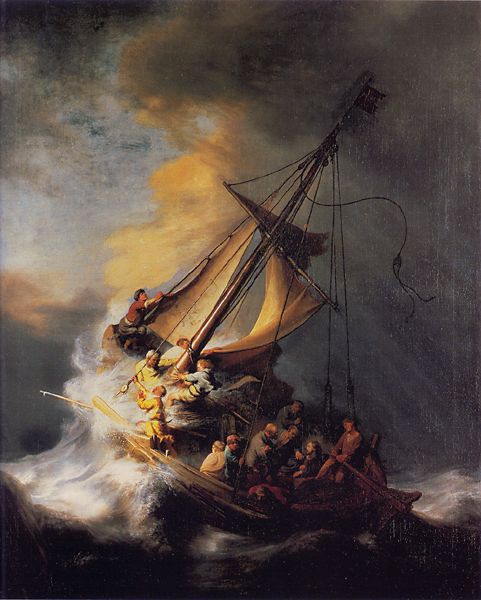
Storm on the Sea Galilee


The Storm on the Sea Galilee, 1633, Rembrandt Van Rijn

I think that this picture has a lot to say to Catholics today. The picture depicts the following Bible passage;

And when he got into the boat, his disciples followed him. A windstorm arose on the sea, so great that the boat was being swamped by the waves; but he was asleep. And they went and woke him up, saying, "Lord, save us! We are perishing!" And he said to them, "Why are you afraid, you of little faith?" Then he got up and rebuked the winds and the sea; and there was a dead calm. They were amazed, saying, "What sort of man is this, that even the winds and the sea obey him?" (Matt 8:23-27)

The picture is cool because the people who are closer to Christ in the picture seem more peaceful while the people further way are in peril. The Church right now is a lot like this picture. It is getting beat up and tossed around. But what we have to remember is to keep faith and call on Jesus. If we trust in him he will get us to our destination safely. God bless

Monday, June 27, 2005

Building Fox Holes

The Death Mask of Blaise Pascal


When I see the blindness and the wretchedness of man, when I regard the whole silent universe and man without light, left to himself and, as it were, lost in this corner of the universe, without knowing who has put him there, what he has come to do, what will become of him at death, and incapable of all knowledge, I become terrified, like a man who should be carried in his sleep to a dreadful desert island and should awake without knowing where he is and without means of escape. And thereupon I wonder how people in a condition so wretched do not fall into despair. I see other persons around me of a like nature. I ask them if they are better informed than I am. They tell me that they are not. And thereupon these wretched and lost beings, having looked around them and seen some pleasing objects, have given and attached themselves to them. For my own part, I have not been able to attach myself to them, and, considering how strongly it appears that there is something else than what I see, I have examined whether this God has not left some sign of Himself. (Blaise Pascal, Pensees)

If we could come to perceive the reality of the human situation would there exist one apathetic soul in the world? We all to some extent ignore our predicament. We chase distraction through entertainment and pleasure so that we do not have to face reality. Maybe this is why, “fear of the Lord” is considered a virtue in Scripture. It is being in touch with the reality of our smallness in relation to the universe, not to mention our utter dependence on God. Can we reveal our situation to those who chase distractions? Will the atheist have the courage to face the reality of our predicament? Can we get past the noise of Modern Culture? Can we communicate our blindness and wretchedness in relation to God? I don’t know, but I believe that we are called to try.