Wednesday, August 22, 2007

The Truth Shall Set You Free

“What we need is not truths that serve us but a truth we may serve.” (Jacques Maritain)

The science only crowd needs to become aware of this insight. Hat tip to Apolonio Latar

Check the Method

Here is a quote from, The Art of War...

36. When you surround an army, leave an outlet free.
Do not press a desperate foe too hard. Link


I think this applies to apologetics as well as literal war. We can do more damage than good with apologetics. It’s kind of like chemotherapy. We attack that which is unhealthy but there is a risk of destroying the healthy as well. So allow some room if someone’s ego gets hurt or if they start to look “desperate”. You do not want to push them farther away.

Apologetics is really not all that glamours. It’s like working a potato farm. But instead of planting seeds your job is just to throw out all the rocks in the soil. Sure there may be some seeds we plant but we really are not doing apologetics when we do this. We also must remember that we are not the one that converts the heart. That is the Holy Spirit’s job.

Godwin's Law

Godwin's Law is good to know when talking to people on the net.

Godwin's Law (also known as Godwin's Rule of Nazi Analogies)[1] is an adage that Mike Godwin formulated in 1990. The law states:[2]

As an online discussion grows longer, the probability of a comparison involving Nazis or Hitler approaches one.

Godwin's Law does not question whether any particular reference or comparison to Hitler or the Nazis might be appropriate, but only asserts that one arising is increasingly probable. It is precisely because such a comparison or reference may sometimes be appropriate, Godwin has argued,[3] that overuse of Nazi and Hitler comparisons should be avoided, because it robs the valid comparisons of their impact.

Although in one of its early forms Godwin's Law referred specifically to Usenet newsgroup discussions,[4] the law is now applied to any threaded online discussion: electronic mailing lists, message boards, chat rooms, and more recently blog comment threads and wiki talk pages. Link

Some say that due to Godwin's Law that if you bring up the Nazis you automatically loose the debate. So unless unavoidable, my suggestion would be to not use the Nazis or Hitler to make a point in a debate.

Tuesday, August 21, 2007

Silence

Music is everywhere. Long live it.

Just give me five minutes without it; that's all I ask, perhaps all I'll need to bring it back into being for myself. Imprisoned by it as I am now, assaulted in every store, elevator, voice-mail system, passing car, neighbor's home, by it and its consequent immolation in the noise of the quotidian, it is lost to me as anything other than a kind of psychic rape, a forced intimacy with sonic partners not of my choosing. When music is everywhere, it is nowhere; when everything is music, nothing is. Silence is as crucial to the musical experience as any of its sounding parameters, and not merely as a kind of acoustical "negative space." Silence births, nurtures, and eventually takes back the musical utterance; it shapes both the formation of its textures and the arc of its progress through time. Link


I find myself seeking music out like it’s a compulsion. I think it is away of avoiding the reality of my aloneness and my dependency on God.

You can get with this...Or you can get with that

To put it bluntly, today Europe appears to have very few values to share. The reluctance of some immigrant to integrate exposes this fact: that those who uphold the European ideal (or at least are supposed to uphold it) are often little emperors with no clothes.

Maybe we need cultural pessimists like Heinsohn in order to wake us from complacency. But then, cultural and political pessimism only breeds a sense of fatalism – and there is nothing inevitable about the fate of Europe. Thankfully, the difficulties afflicting Europe in the current period are not the consequence of laws of nature or of irreversible demographic forces. Europe is politically, not physically, exhausted. What we need to do is renew public life by having a grown-up discussion about the kind of societies we want to live in. We need to encourage genuine political experimentation, and overcome our addiction to the technocratic fixes pursued by the EU elites. Let us begin by acknowledging that, indeed, the emperor has no clothes. Link


I mostly agree with this prognosis but I would take it a step further. The problem with post modern secular Europe is that is is Godless and gutless. Rather than having a “grown-up discussion” I would recommend that Europe reject the culture of death (as in start having children) and run as fast as possible to its Judaeo -Christian roots. If not, prepare to be an Islamic nation.

Monday, August 20, 2007

Can I Live


Nuff said.

Old Testament Difficulties and the Ban

One of my earliest memories is watching tv while my parents wallpapered the room. I was probably around 5 years old. My dad had got a bag of M&M’s when he bought some of the wallpaper supplies. I remember my dad telling me that I needed to stop eating the M&M’s because I was going to get a stomach ache. I ignored him and kept eating. He told me again to stop eating because I was going to make myself sick. I have talked with my dad about this incident when I was an adult and he remembered it. He told me that I gave him a look that said, “you cheap ass”. My dad finally said, “Fine, eat as much as you want.” I got a terrible stomach ache that night. I can remember not being able to sleep and crying. I learned something from this and my dads words gained more weight after that night. My dad was telling me to stop for my own good.

We have a tendency to have to see for ourselves how things are. To take God’s word is not enough. We have to learn for ourselves. He tries to set things one way but we think we know a better way.

The following is from the Bible that gives an example of this....

Then I gave them my statutes and made known to them my ordinances, which everyone must keep, to have life through them. Ezeikiel 20:11

But the house of Israel rebelled against me in the desert. They did not observe my statutes, and they despised my ordinances that bring life to those who keep them. My sabbaths, too, they desecrated grievously. Then I thought of pouring out my fury on them in the desert to put an end to them. Ezeikiel 20:13

But their children rebelled against me: they did not observe my statutes or keep my ordinances that bring life to those who observe them, and my sabbaths they desecrated. Ezeikiel 20:21

Therefore I gave them statutes that were not good, and ordinances through which they could not live. I let them become defiled by their gifts, by their immolation of every first-born, so as to make them an object of horror. Ezeikiel 20:25-26

The examples that you gave in regards to kids being destroyed along with the whole city I think fits into this category. It was called a "ban". Other cultures during the OT times would slaughter the whole city as a sacrifice to their god. [each area had a specific god] It was a show off thing. Our god is so great that he deserves the sacrifice of a whole city (Deut. 7:1,2) and our devotion is so strong that we do not take the spoils of war but offer them to God (Josh. 6:17). [ban means "devoted"] I believe that the Israelites got caught into this line of thought. They demanded showing God this devotion to show off how worthy their God was and how devoted they were even though God did not want this type of sacrifice.

“If you had known what these words mean, ‘I desire mercy, not sacrifice,’ you would not have condemned the innocent.” (Matthew 12:7)

It is true that God is ultimately worth all the sacrifice of the world [a perfect one even Malachi 1:11] and it is also true that the Israelites don’t deserve any of the rewards but I don’t believe that this is what God ultimately wanted.

The Bible was not written by God possessing someone and writing for them or dictating to them word for word what to write. The holy Spirit inspires the author and the author uses his own culture and experiences to convey what God is saying. The ban was a half truth that foreshadowed the ultimate true and perfect sacrifice of the cross.

Saturday, August 18, 2007

The Meaning of Death


The question of the meaning of death is also the question of the meaning of life, the greatest of all questions. Don Quixote is talking about this when he tells Sancho Panza about the look he saw in the eyes of the soldiers who lay dying in his arms; the eyes seemed to be asking a question. Sancho asks, “Was it the question ‘Why am I dying?” and Quixote replies, “No, it was the question, ‘Why was I living?’”

Because of death, the question of the meaning of life leads to one of two answers. Because death exists, because life ends in death, because the final fact about life is death, life is either startlingly more meaningful or startling less meaningful than we usually think. For if even death is meaningful, then life is startlingly more meaning-full; than we usually think; and if death is not meaningful, then life, is the final analysis, is not meaning-full. For death is the final analysis. If there is nothing at the end of the road, then the road leads nowhere, points to nothing, means nothing. No compromise is possible on this, the ultimate question: Is life as a whole, life in the long run, meaningful or meaningless? Life cannot be meaningful in the short run and meaningless in the long run, because the long run is the meaning of the short run. “One foot up and one foot down/ That’s the way to London Town” -if there is no London, or if it’s not worth going to, then there’s no reason to put one foot up and one foot down.

So life is either totally meaningful or totally meaningless, depending on what death is. Therefore we have better try to find out what death is. Peter Kreeft, Love is Stronger than Death

Old Testament Laws

Why did God sometimes set laws in the Old Testament that current Christians would now see as immoral?

Couple of things to remember.

1. God did not give his revelation all at once. It developed as humans were better able to understand His revelation and it continues to develop to this day. The Old Testament is a foreshadowing of the New Testament. It was to prepare His people for the coming of Jesus

2. God did not demand His people to live to his standard all at once. In his mercy, God started where people were at, not where his justice demanded them to be. An example...

People naturally want to beat their enemies to the first punch. “Im going to get him before he gets me” It is also natural for people to want to hit back harder than they have been hit. This is really were the people were at during the Old Testament. God ratcheted things up when he set the standard to an “eye of an eye”. Is an “eye for an eye” the full revelation? Nope, but God did not call His people to make quantum leaps that they were not going to make. Jesus ratcheted up the standard again when he asking us to love our enemies. Our society does not live up to this although this is what God is calling us to do. This is such a high standard that it is still hard for us to understand.

If you look at the Old Testament it is really a dialog between God and his people. God calls them to something that is closer to him and the people try and fall away. God then calls them back and they try and they fall away. This happens over and over. But the morals standards in the Old Testament that you are having an issue with are a step closer to God’s justice. Did God’s justice change, no God still and always has demanded perfect justice, but through Jesus’ cross he was also able to bring mercy, without it no one can be saved.

Friday, August 17, 2007

Handing Out $5 Words


iconoclast

Main Entry: icon-o-clast

Etymology: Medieval Latin iconoclastes, from Middle Greek eikonoklastEs, literally, image destroyer, from Greek eikono- + klan to break -- more at CLAST
1 : a person who destroys religious images or opposes their veneration
2 : a person who attacks settled beliefs or institutions


Iconoclasm

Iconoclasm (Eikonoklasmos, "Image-breaking") is the name of the heresy that in the eighth and ninth centuries disturbed the peace of the Eastern Church, caused the last of the many breaches with Rome that prepared the way for the schism of Photius, and was echoed on a smaller scale in the Frankish kingdom in the West.

I figured it would be cool to have a weekly apologetic vocabulary post. Who am I kidding. I just wanted to have a post with this awesome picture. Here is where I got the pic. Link

Death and Culture


Think of this, too, in terms of the family. In all Western cultures, a person was once “gathered to his fathers.” But constant relocation and the urban distaste for cemeteries have made care of graves difficult. Why shouldn’t we expect family tradition to weaken at the same time as family graves begin to disappear?

Indeed, the logic loops back on itself to spiral downward: The failure to maintain the family graves increasingly leaves the family name without meaning, and the emptiness of the family name increasingly becomes a reason not to have family graves. The modern failure of funerals serves as both a cause and a symptom of the shattering of culture, first into the nuclear family, then into atomized individuals, and at last into nothingness—with, for instance, the increasing use of “anonymous death,” a European innovation now beginning to appear in America, where the dead are abandoned without ceremony in deliberately unmarked graves, or their corpses are cremated with the ashes spread across large and indifferent spaces. Link

I have had the tendency to see memorial day as a waste of time and resources. I now believe, after reading this article, that my attitude was wrong.

Wednesday, August 15, 2007

Face Down


Lyrics: Red Jumpsuit Apparatus - Face Down

Lyrics

Do you feel like a man
when you push her around?
Do you feel better now as she falls to the ground?
Well I'll tell you my friend, one day this world's going to end
as your lies crumble down, a new life she has found.

A pebble in the water makes a ripple effect
every action in this world will bear a consequence
If you wade around forever you will surely drown
I see what's going down.

The Bayesian Revolution


So we find that many phenomena in the cognitive sciences, plus the statistical methods used by scientists, plus the scientific method itself, are all turning out to be special cases of Bayes' Theorem. Hence the Bayesian revolution. LINK

This link is not an easy read but I think the topic is important for apologetics. From what I can gather, Bayesian reasoning assigns probability to evidence. The classic philosophy of science is that a theory is able to be disproved but not proved. Bayesian reasoning is different in that a probability is assigned to the evidence against a theory but also the evidence for a theory. This method of weighing evidence is being used in the cognitive sciences where evidence is very complicated. We need to understand how this works because this method of weighing evidence is bound to be used in regards to religious evidence. The real motive of why I’m posting this is that my sister told my parents that my blog was not as intellectually challenging as it was in the past. So this ones is for you Jeanne.

God’s Art


I sometime watch the artist named Bob Ross on PBS. If you ever seen him you would know that he is a white, disco, afro sporting, painter. I have watched him work and the things he does look awesome. There has been times when he is painting something beautiful and he will make a large dark mark almost in the center of the painting. I will think to myself, “What the hell is he doing, he just messed up a beautiful painting.” But after letting him finish, he ends up making something that is more interesting and beautiful than what I first expected. God in human history works somewhat like this. What we interpret as God messing up can in realty turn into something more beautiful.

Another analogy is if you ever watch a painter that slaps the paint on the canvas in what looks like a random matter. It looks like the artist has no rhyme or reason to what he is doing. But once he is almost done it all of a sudden pops out to you what he is doing. In the middle of human history we do not have the perspective to see what God is ultimately doing. Like the artist what looks random but isn't, God is doing something beautiful although it looks to us like randomness. We really won’t have the perspective until God is done with history. Now this perspective takes faith that the artist knows what he is doing.


These analogies fall short in many ways. One being that humans play a part in God’s artwork in human history. This make it even more complicated to interpret what God is doing. When an artist uses a brush, the brush cannot choose to reject the artists work, while humans can. Through this, in a way, we are able to share in God’s glory.

Thursday, August 09, 2007

Advice on Witnessing to Muslims

A Post written by Cathoholic Anonymous obtained at Phatmass

What Never to Do

1.) Don't assume that you know more about Islam than the Muslim standing in front of you, just because you've read a Wikipedia article on jihad and have memorised a few Arabic terms that you can barely pronounce. You don't. Respect their knowledge and don't insult their intelligence.

2.) Don't argue about the Qur'an with Muslims. Again, their knowledge of its meaning and interpretation is likely to be far beyond yours - no matter how many pseudo-scholarly Robert Spencer books you've read. If you come out with the tired old "Islam preaches death to the infidel" line, the average Muslim will immediately think, "Here is another one who is trying to make out that I believe things that I don't. Why should I listen?"

3.) Don't make the mistake that Budge's article makes and assume that Islam is an Arab religion or that the majority of Muslims are Arabs. Be sensitive to the culture and nationality of the individual. They will respect you more for it.

4.) Do not drag up honour killings, female genital mutilation, or the death penalty for adultery. The majority of Muslims have no intention of committing a so-called honour killing, mutilating their daughters' genitals, or committing adultery, but nearly all of them will have misconceptions about the Trinity and what it means to profess faith in Jesus' divinity. Talk about stuff that they actually believe and that is actually relevant.

Useful Topics to Discuss

1.) Monotheism. Many Muslims have real difficulty with understanding how Trinitarian faith can be truly monotheistic. In Saudi curious and well-meaning people would quite often ask me, "Why do you worship three gods?" The more knowledgeable would ask, "How can God be three distinct Persons but still have the same essence?" This is a big area of interest and confusion, so make sure that you are knowledgeable. (It is also worth noting that a lot of people who convert away from Christianity do so because of a poor grasp of Trinitarian theology.)

2.) The incarnation. A lot of Muslims have a hard time distinguishing the difference between the theology of the incarnation and outright idolatry. The best place to begin a discussion about Jesus' divinity is with Mary. Muslims have considerable respect for Mary (Marian-related sites in the Holy Land are places of pilgrimage for Muslims too, especially her well at Ein Kerem). There is Qur'anic support for both the Virgin Birth and the Immaculate Conception, so this is an ideal place to begin discussion about Jesus' life.

3.) The crucifixion. The primary Islamic argument given against Jesus' tormet is that God would never allow such a noble prophet to suffer such an agonising death. A different concept of God is at work here. Muslims envisage Him as being exalted, glorious - He would never share in human suffering. Yet the glory of Jesus was the cross. The entire suggestion is revolting to Muslims. This is a delicate topic for that reason and should be approached with sensitivity.

4.) Sin, free will, and the hope of redemption. Muslims are, by and large, believers in double predestination. (Not all of them are, so ask the person you are talking to what s/he thinks about this topic before proceeding.) As in Judaism, 'salvation' is a foreign concept to most Muslims. Forgiveness is not. One of the ninety-nine names of Allah is 'the Great Forgiver'. Talk about the person's image of divine forgiveness. Is there a limit to it? What must a person do to receive mercy? Is it a gift for everyone? Is there any tangible evidence of mercy on earth? (This discussion could lead to the centrality of the crucifixion and resurrection in Christianity.)

Other Advice

1.) Talk with people, not at them. Realise that their spirituality is not all about 'holy wars' and 'honour killings', that they have a genuine love for God, and that you are questioning something that is very precious to them. Be gentle. I've seen a lot of missionaries at work with Muslims, all with the best of intentions and many of them with the subtlety of your average kitchen mallet. They do more harm than good.

2.) Ask questions about the person's understanding of and concerns about Christianity. A lot of Muslims whom I've met are put off by the lack of structured, disciplined prayer that they see in Christianity. They are very attached to their five daily prayers and regular remembrance of God. (This is where the Divine Office comes in very useful.) Others may be worried by the lack of modesty that they see in the dress of Christians. Still others are concerned that they will be expected to start aggressively condemning their Muslim family and cut off all ties with their friends. The concerns vary from person to person. Listen and understand.

Time For a Chesterton Moment

Now what we have really got to hammer into the heads of all these people, somehow, is that a thinking man can think himself deeper and deeper into Catholicism, and not deeper and deeper into difficulties about Catholicism. We have got to make them see that conversion is the beginning of an active, fruitful, progressive and even adventurous life of the intellect. For THAT is the thing that they cannot at present bring themselves to believe. They honestly say to themselves: "What can he be thinking about, if he is not thinking about the Mistakes of Moses, as discovered by Mr. Miggles of Pudsey, or boldly defying all the terrors of the Inquisition which existed two hundred years ago in Spain?" We have got to explain somehow that the great mysteries like the Blessed Trinity or the Blessed Sacrament are the starting-points for trains of thought far more stimulating, subtle and even individual, compared with which all that sceptical scratching is as thin, shallow and dusty as a nasty piece of scandalmongering in a New England village.

Thus, to accept the Logos as a truth is to be in the atmosphere of the absolute, not only with St. John the Evangelist, but with Plato and all the great mystics of the world. To accept the Logos as a "text" or an "interpolation" or a "development" or a dead word in a dead document, only used to give in rapid succession about six different dates to that document, is to be altogether on a lower plane of human life; to be squabbling and scratching for a merely negative success; even if it really were a success.

To exalt the Mass is to enter into a magnificent world of metaphysical ideas, illuminating all the relations of matter and mind, of flesh and spirit, of the most impersonal abstractions as well as the most personal affections. To set out to belittle and minimise the Mass, by talking ephemeral back-chat about what it had in common with Mithras or the Mysteries, is to be in altogether a more petty and pedantic mood; not only lower than Catholicism but lower even than Mithraism
--G.K. Chesterton, The Thing

Wednesday, August 08, 2007

Evolution as Ethics

The results were just what the researchers hoped for. In the romantically primed group, the men went wild with the Monopoly money. Conversely, the women volunteered their lives away. Those women continued, however, to be skinflints, and the men remained callously indifferent to those less fortunate than themselves. Meanwhile, in the other group there was little inclination either to profligate spending or to good works. Based on this result, it looks as though the sexes do, indeed, have different strategies for showing off. Moreover, they do not waste their resources by behaving like that all the time. Only when it counts sexually are men profligate and women helpful. (Link)

Basically the study shows that men and women are more likely to act altruistic when it is advantageous to show off to the opposite sex. Nothing life shattering about this. Our motives are rarely (if ever) totally pure. What I have a problem with is the idea that altruism is only the result of evolutionary mechanics and this is what the article is trying to suggest. Humans are free to be altruistic without the primary motive being the accusation of an evolutinary advantage . A moral system based on evolution is going to lead to an evil society but this is where a portion of our society is trying to lead us. Why, because science must take over ethics and the meaning of man's existence.

Tuesday, August 07, 2007

Diversity is not an Intrinsic Virtue

Robert Putnam..... has found that the greater the diversity in a community, the fewer people vote and the less they volunteer, the less they give to charity and work on community projects. In the most diverse communities, neighbors trust one another about half as much as they do in the most homogenous settings. The study, the largest ever on civic engagement in America, found that virtually all measures of civic health are lower in more diverse settings. Link

This information can be used for evil ends with racism being an example. But diversity just for the sake of diversity never made a lot of sense to me. I think when relating with anyone there has to be something that is sacred which is shared to bridge the gap or it will never work. The Catholic Church is diverse in the many types of people that belong to the faith. It is truly universal but it only works with Christ being the corner stone. What will be the cornerstone for America as it becomes more diverse?

Neville Crushing the Head of the Serpent

In Harry Potter it is rather clear that Harry plays a Christ type role in the final book. Harry lays down his life for his friends, ends up in a train station type purgatory where he is given the choice to go back to finish the job. Along these lines I think that Neville Longbottom plays the typological role of crushing the head of the serpent found in Genesis 3:15 when Neville chops off Voldemort's snake's head. Call me crazy but that’s how I see it.
Here is a cool new blog that talks about the similarities between Neville and Sam in the Lord of the Rings that I found interesting. Link

Sunday, August 05, 2007

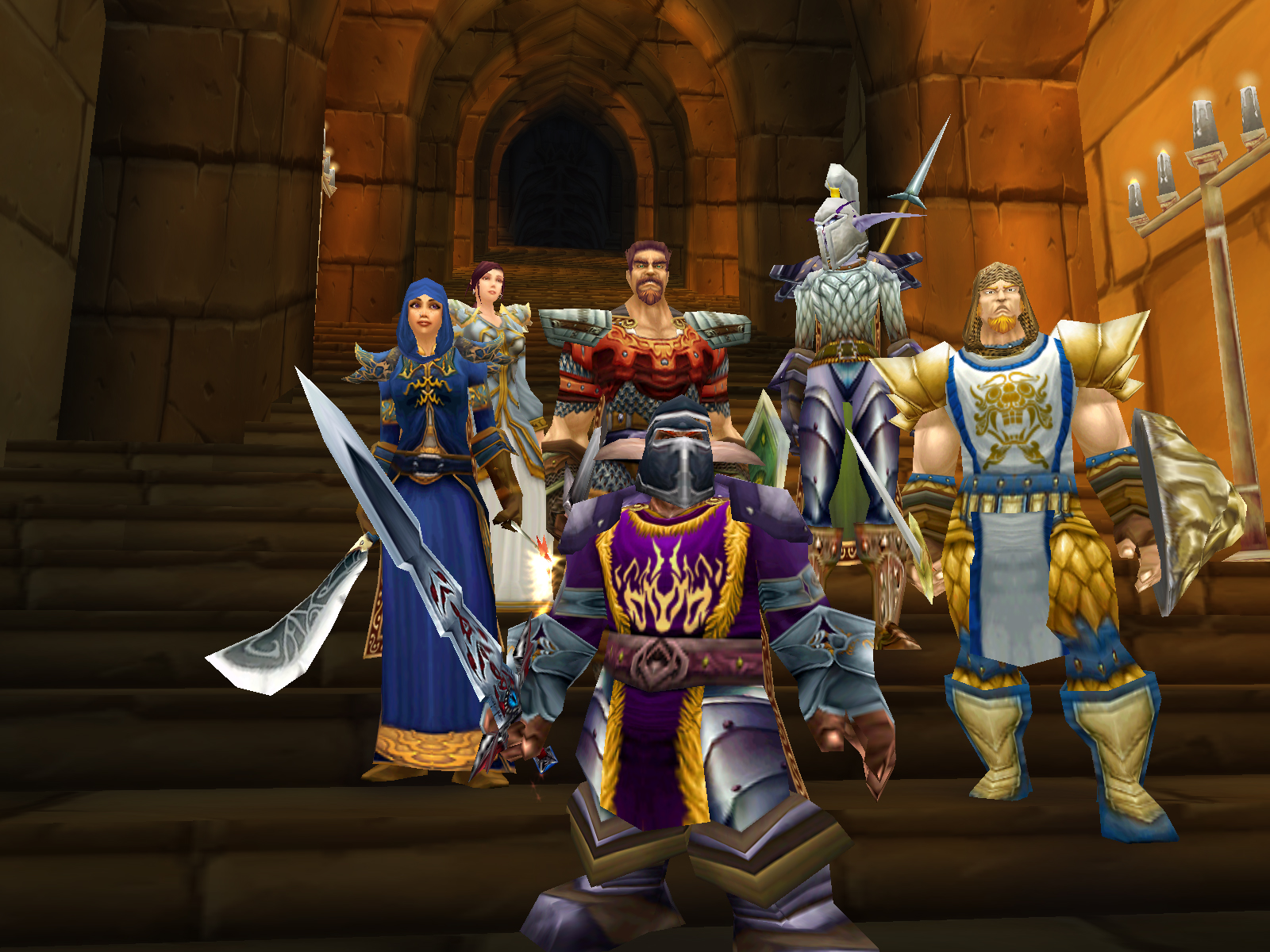
World of Warcraft: A Cautionary Tale


I’ve been playing the online game, World of Warcraft (WoW) and this explains my absence on this blog. WoW has been very fun and entertaining. The game manufactures a sense of achievement as you progress your character and this was satisfying. There is a social aspect to WoW that makes you feel like you are connected. The truth is that the satisfaction I got from the game progression and social connectedness are an illusion that I have wasted too much of my life on.

You might be thinking, yes, captain obvious, WoW is a online fantasy game and as such it is a digital illusion. I think as you get into WoW this truth becomes less obvious. When I am mentally into that grove of the game, it is really hard to think about anything else. The game starts to carry the same weight and feel as real life priorities. WoW never ends so there is always the feeling that there is something left undone that must be completed. Aspects of WoW are a lot like gambling in that the reinforcement methods are the same as slot machines. But instead of money you insert your time. We all have the need of social interaction and the need to accomplish something in life. WoW provides this in an easy but fraudulent way. I have invested a lot of myself into this game and it has not produced any fruit. The game instead has had a negative impact on my relationship with my wife, children, and Christ . I have decided to stop playing.

This makes me think about how much of my life fits into this category of illusion. What else in my life gives me a sense of social connection and achievement
fraudulently. My online involvement with bloging, posting on forums, emails, and online apologetics have a lot of similarity to WoW. When stopping WoW could I be just trading one lie for another? I am going to try to pray more so that I will be able to answer this question.

Here is a video that gives a better idea of what WoW is.


[fast forward the video until you see faces if you do not want to hear bad language]